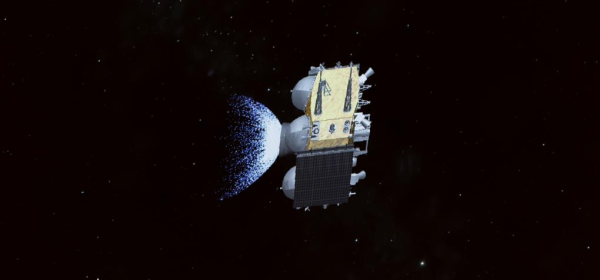
The control system of Chang’e-6 has also been enhanced to improve its autonomy, enabling it to complete lunar take-off and ascent with reduced reliance on the Queqiao-2 relay satellite and ground support, said Huang Hao, another space expert from the CASC.
The ascender is expected to carry out unmanned rendezvous and docking with the orbiter-returner combination in lunar orbit, and the samples will be transferred to the returner.
The orbiter-returner combination will orbit the moon, awaiting the optimal time to transfer back to Earth. When it approaches Earth, the returner carrying the lunar samples will re-enter the atmosphere, aiming for a touchdown at Siziwang Banner in north China’s Inner Mongolia Autonomous Region, the CNSA said.



 SANGHA KOMMUNE (SSR)