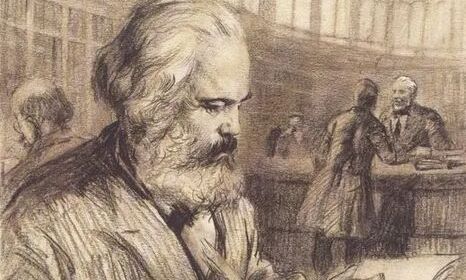
Marx encountered Buddhism through the work of his close friend Karl Koppen – an early European expert upon Early Buddhism and Tibetan Buddhism.
Proletariat Blogging in the Heart of (UK) Predatory Capitalism! Exploring the Interface between Matter and Perception, Chinese Buddhism, Daoism, Hakka Ethnography, and All Aspects of Radical Politics, History, Psychology and Philosophy – 全世界无产者联合起来!
Marx encountered Buddhism through the work of his close friend Karl Koppen – an early European expert upon Early Buddhism and Tibetan Buddhism.
Within the received chain of dependent origination (paticca-samuppāda), the Buddha uses the term ‘namo-rupa’ or ‘mind-body’ – to explain that these two otherwise distinctive entities are inherently ‘linked’ or ‘entwined’ at source, and within his schematic of interpreting reality, cannot be considered ‘separate’ in any manner.
Enlightenment is not the acceptance of, or practical experience of rebirth. Enlightenment is not the acceptance of, or practical experience of a ‘soul’ theory. In other words, a fully enlightened and rational mind, is a mind ‘emptied’ of all delusion and irrationality.
The Buddha explained that physical existence is ‘nama-rupa’, or ‘mind-body’. This analysis is found in the received Chain of Dependent Origination (specifically in the 4th link which is conditioned by consciousness [mind], and which in turn conditions the sixfold sense-base [body]).
Through the work of Nagarjuna, the Mahayana movement developed the interpretation that physical matter is ‘empty’ of any substantiality. This is due to Nagarjuna applying his tetra lemma (catuskoti) formula to the assessment of the ‘Chain of Dependent Origination’ (Pratītyasamutpāda), and logically proving that just as the true enlightened state has no-self associated with it; then it is also equally true that physical matter has no substantiality associated with it. Everything is dependent upon everything else, conditioned by everything else, and contingent upon everything else.
 SANGHA KOMMUNE (SSR)