The Emus Launched a Highly Disciplined Attack1

1932: The Great Emu War – Australia’s Islandlwana? (31.3.2026)

On November 2nd 1932, Major GPW Meredith of the Royal Australian Artillery, together with two soldiers (in a truck), was dispatched with two (Lewis) machine guns and 10,000 rounds of ammunition to address the Emu problem (the battle would last until December 10th 1932). The Emu Army suffered around 986 killed in action – (with numbers of wounded unknown) over a time-period of one month, one week, and one day. Considering the Emus were unarmed and lacked the intellectual ability to foresee their impending doom – these losses are considered “minimal” and something of a strageic defeat for the Australian Army. Yes – the Emu Army, by employing only the advantageous bestowed upon them by evolution through natural selection – it is often believed that the Emu Army inflicted a strategic defeat on the Australians! As the bullets came pouring-in – the massed Emus “scattered” in all directions and ran into the outback where their human pursuers could not venture.
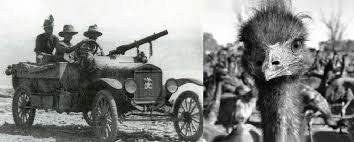
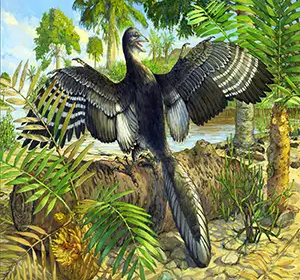
Illustration showing Archaeopteryx in life, including its tertial feathers that would have helped it fly. Credit: Michael Rothman. Click image to enlarge.

US: Ongoing Analysis of – Archaeopteryx Fossil – Continues to Proves Darwin Right! (21.3.2026)

Differences in modern birds

Modern birds evolved shorter upper arm bones and specialized tertial feathers to close this gap.

Remarkably, the Chicago specimen of Archaeopteryx shows it had long tertial feathers too – something unseen in its flightless dinosaur relatives.

“Our specimen is the first Archaeopteryx that was preserved and prepared in such a way that we can see its long tertial feathers,” she noted.

These feathers, absent in closely related non-avian dinosaurs, suggest those creatures couldn’t fly.

“That tells us… Archaeopteryx could,” O’Connor added. “This also adds to evidence that suggests dinosaurs evolved flight more than once – which I think is super exciting.”

State of the Art Sun-Dial - Down House - Kent

Down House: Donning a Bowler Hat & Beard – Charles Darwin Lives! (7.3.2026)

It is a beautiful manor house situated in Kent – with a large garden full of all the natural experiments Darwin developed over many decades – as he slowly but surely correlated the information he had gathered in his youth aboard the HMS Beagle. He further developed all this by closely observing how nature functioned and unfolded in his native England – realising that environmental conditions (natural selection) creates changes in living organisms so a to better enhance the chances of a) survival, and b) reproduction. Whether occurring in South America, the Pacific, or the UK, the evolutionary forces acted in exactly the same way. Of course, what is near at hand to each of us becomes the “familiar” – and what is far away becomes the “unfamiliar”. However, this is just a matter of sensory “immediacy” – the point that Darwin made is that there is a greater principle underlying it all that we, as individuals, must strive to appreciate and understand. As part of this process, myself, Ge, Mei-An, and Kai-Lin all donned bowler hats and fake beards – so that we could – even if only for a moment – become Vharles Darwin!

Carshalton Ponds - Slip-Way!

Honeywood Museum: Charshalton Ponds & Billiard Room! (21.2.2026)

We visited the Honeywood Museum in nearby Carshalton Ponds – as the Staff and Management added a Chinese New Year display to the usual mixture of local history artefacts. We have visited in the past – but I do not recall the impressively “large” Billiard Room which seems to have been converted to a “Snooker Room”. Me and Gee sat and drank a cup of coffee outside the Honeywood Museum – watching the numerous types of birds traverse the surface of the water. I think we entered the Museum probably in the wrong direction – and immediately emerged in the Billiard Room – which seemed to corelate seamlessly with Pond itself. During Victorian times, the well to do, those who owned local business and large country-homes – often could often afford all the lateest scientific devices. The air around the Ponds was fresh and yet mild – a thoroughly invigorating experience!

Greek Bird

Daoism Email: Birds Sing in China – Birds Sing in Greece! (14.7.2025)

We do not charge money when sharing knowledge – and as long as we can afford the hosting fees – this website will remain open and free to use for everyone! Even if a time comes when this is no longer possible – I hope the articles will have been copied and passed on as is for the general benefit of humanity. Remember, breathing costs nothing, and being aware of breathing costs nothing – so there is no profit margin! Away with all the charlatans of the world and those who try to sell you your own bodily processes! A cultivated wisdom sees through this kind of inherent ignorance which is a sign of the times.

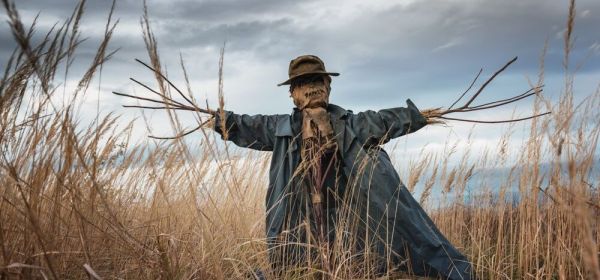
British Scarecrows - Linked to Pagan Gods!

UK: Are Scarecrows Linked to Pagan Fertility Gods? (22.6.2025)

This may be due to the Celtic traditions developing within heavily forested areas prior to the arrival of the Romans – who cleared trees to build their straight roads. Romans also cleared forested areas to create farming fields – so open fields were “foreign” to the British Celts. The Druids are reported as detesting the Roman habit of destroying the sacred woods (the Druids and their Celtic Army were finally beaten by the Romans at the Battle of Anglesey circa 60 CE – the last time “magic” was known to have been used on a British battlefield). During these times, crops were planted within the safety of the forested-canopy – where the Gods of Fertility operated more or less unaffected by the wild birds. Wide, open fields were not yet accepted as “British”. It might have even been the case that Celtic farmers came to some arrangement with the wild birds – setting aside some food for them so that everyone got on without conflict. There was 800-years between the Romans (5th century CE) leaving and the plague creating the conditions that led to the development of the modern British Scarecrow (14th century CE). 

1 2 3 4