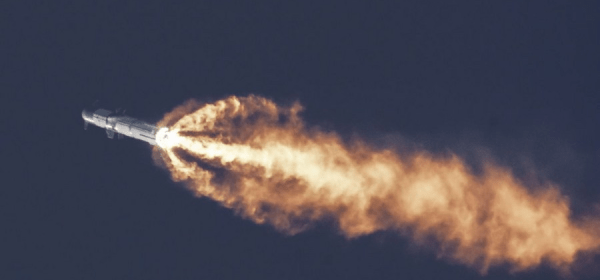
SpaceX’s Starship spacecraft and Super Heavy rocket, collectively referred to as Starship, represent a fully reusable transportation system designed to carry both crew and cargo to Earth orbit, the Moon, Mars and beyond.
Starship will be the world’s most powerful launch vehicle ever developed, capable of carrying up to 150 metric tonnes fully reusable and 250 metric tonnes, according to SpaceX.
To date, the SpaceX team has completed multiple sub-orbital flight tests of Starship’s upper stage from Starbase, and also conducted numerous tests of the Super Heavy rocket, which include the increasingly complex static fires that led to a full-duration 31 Raptor engine test, according to SpaceX.
NASA awarded SpaceX contracts worth several billions of U.S. dollars to use Starship to ferry American astronauts to the surface of the moon under the space agency’s Artemis program.
NASA has announced plans to use a Starship to put astronauts on the lunar surface in 2025.

 SANGHA KOMMUNE (SSR)