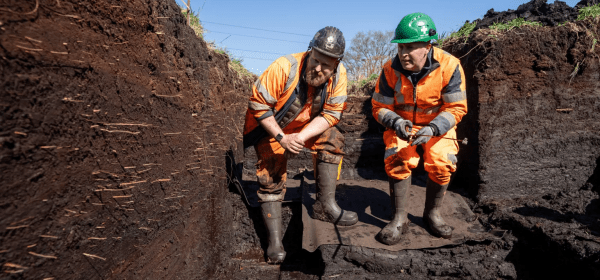
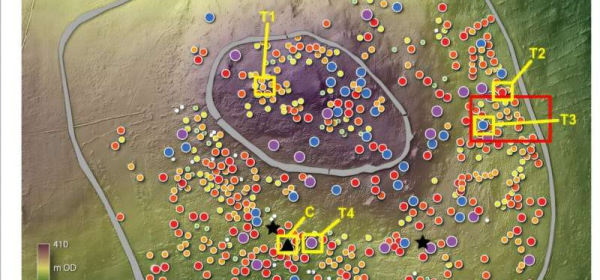
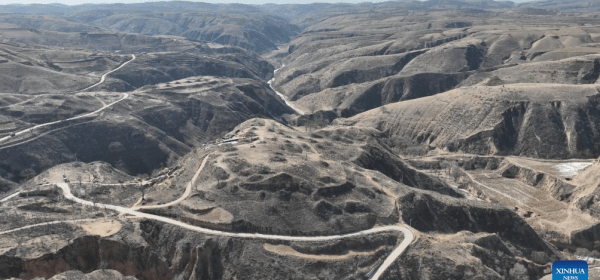
This file photo shows ancient stone fortresses in Yulin, northwest China's Shaanxi Province. (Photo by cultural heritage and archaeology team of the city of Yulin/Xinhua)

China: Survey Team Discovers 573 Ancient Stone Fortresses in North-West! (13.11.2025)

The survey revealed that these settlements spanned from about 2800 BC in the late Yangshao period to around 1000 BC in the Shang and Zhou (1046-221 BC) dynasties.

Mostly distributed along riverbanks, the stone fortresses were surrounded by numerous ordinary settlements without defensive stone walls, indicating a clear clustered relationship, said Ma Mingzhi, head of the team.

The development of these stone fortresses shows a clear evolution from small to large in scale, from simple to complex in layout, and from rudimentary to mature in construction techniques — with social hierarchy becoming increasingly distinct.

The survey provides crucial information for a comprehensive understanding of the origin, development, spread and evolution of prehistoric settlements in northern China, Ma added.

Homo Lomgi - Chinese Ancestor!

China: New [Evolutionary] Finding May Rewrite Human Family Tree! (26.9.2025)

The reanalysis further pushes back the divergence time of modern humans — Homo sapiens — whose ancestors are estimated to have lived in Africa around 500,000 years ago, Neanderthals, who lived between 24,000 and 130,000 years ago in Europe, and Homo longi, a species closely related to Denisovans, who thrived from 30,000 to 285,000 years ago across Asia and are the cousins of Neanderthals.

Archaeological Teams in Henan!

China: Longest Ancient City Road Discovered at 3,300-Year-Old “Yin” Capital Site! (27.12.2024)

The main roads discovered in this area are spaced 320 to 550 meters apart, while some intermediate-level roads are located about 100 meters apart. These roads are interconnected, showing clear evidence of intentional human planning, according to Niu.

Based on previous findings of archaeological excavations, it has been confirmed that the roads in the Shang capital city can be generally classified into three levels according to their width, or referred to as main roads, streets and alleys, Niu said.

Situated in Henan’s Anyang City, the 3,300-year-old Yin Ruins is the first documented late Shang Dynasty capital site in China, as confirmed by archaeological excavations and oracle bone inscriptions.

Bristol Mass Grave - 2024

Bristol Housing Site: Disturbing Mass Grave Uncovered! (24.10.2024)

During that period, foreign fighters, largely sailors captured during conflicts with France, Spain, Holland and the early United States were held there and, it would appear, often died there.

Significantly the site’s use for this pre dates the creation of the Norman Cross camp in Huntingdonshire, which is sometimes described as the world’s first purpose built prisoner of war camp.

In the 19th century it was then used as a hospital, including in 1832 when Bristol was hit by a cholera outbreak and in 1837 it was turned into a Victorian Workhouse, which were kind of like homeless shelters but notoriously brutal, providing people with food and shelter in exchange for manual labour.

It’s thought the remains are likely to date from each of these three periods.

A statement sent to Greatest Hits Radio by housing developer Vistry, says research on the remains will “contribute to understanding of Bristol’s social and economic history”.

Romans Were All Dominant and Crushed the Zionists with Ease!

Masada: Roman Siege Ended in Just ‘2-Weeks’ – Not ‘3-Years’ – Debunking Zionist Propaganda! (14.9.2024)

Until recently, popular narrative suggested that the Roman army found it very difficult to take the Masada fortress, standing as a symbol of Jewish heroism in modern Israel.

For many years, it was assumed that this siege, one of the final moments of the First Jewish-Roman War, took nearly three years, but researchers have begun to challenge this belief.

Previous studies provide insights into the quantity of earth and stones a Roman soldier could move in a single day.

There are also records that about 6,000-8,000 soldiers participated in the siege of Masada.

Using this information, scientists could calculate how long it took them to build the entire siege system which included eight camps and a stone wall surrounding most of the site.

“We found that construction took merely about two weeks,” Hai Ashkenazi, another author of the study, said.

“Based on the ancient historical testimony it is clear that once the assault ramp was completed, the Romans launched a brutal attack, ultimately capturing the fortress within a few weeks at the most. This leads us to the conclusion that the entire siege of Masada lasted no more than several weeks,” Dr Ashkenazi said.

Many Non-Han People Visited the Noth-West Region!

China: Ancient Silk Road Museum of Underground Tombs Complex – Opens in Xinjiang! (16.7.2024)

A large cache of pottery and bone ware and coins unearthed from the tombs are also on display in the museum.

“The museum makes full use of the original appearance of the tombs, as well as digital exhibition, VR technology and touch screens to offer the audience an immersive experience of the ancient Qiuci,” said Feng Wei, deputy curator of the museum.

According to the Xinjiang regional institute of cultural relics and archaeology, four excavation rounds were carried out from 2007 to 2023 at the site in Kuqa, which led to the discovery of more than 2,000 relic sites. In addition to the tombs, there are wells, cooking stoves and other relics dating from the Spring and Autumn Period (770-476 BC) up to the Ming and Qing dynasties (1368-1911).

1 2 3 4