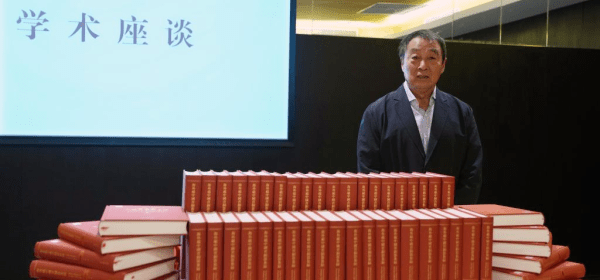
Professor Zhu Fenghan, the lead editor of a sixty-volume compendium documenting more than 23,000 ancient Chinese bronze artifacts lost abroad, poses for a photo during a press conference for the books' release in east China's Shanghai, April 19, 2026. (Xinhua/Liu Ying)

China: Record of “Stolen Bronzes” By Imperialists Compiled! (20.4.2026)

Zhu, also the lead editor of the books, said previous such surveys focused mainly on bronze bells, cauldrons and ritual vessels. This collection categorizes nearly 300 types of bronze artifacts, ranging from weapons, tools, lamps and mirror stands to irons, coal rakes and dice. One example is a human-shaped lamp stand currently at the Minneapolis Institute of Art.

Previously, scholars at home and abroad generally assumed that there were over 3,000 Chinese bronze wares in overseas collections. However, the “Collection of Chinese Bronzes in Overseas Collections” has expanded this figure by more than sevenfold.

“We have created an identity document for each piece of relics,” Zhu said. The team found that only a few relics have clear records of legal trade, diplomatic gifts or legitimate export.

As the compendium points out, the primary channels for these bronzes leaving China from the late 19th century to mid-20th century were looting, smuggling and war plunder. Western collectors and dealers bought large numbers through agents inside China, forming an illegal supply chain.

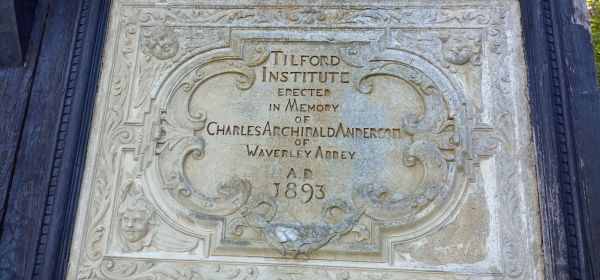
The charity plans to make the site accessible to the public

UK: Heighington Station [1827] – First Train Platform in World! (19.1.2026)

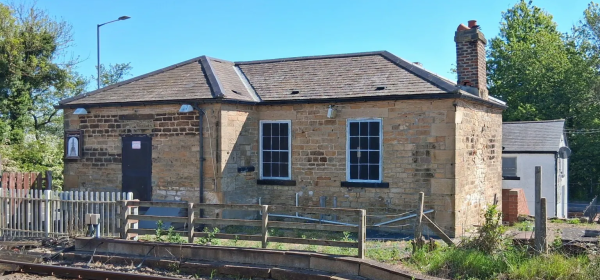
Last year Heighington Station, which dates to back to 1827 and was part of the first passenger railway to use steam trains in the world, was bought by the charity Friends of the Stockton and Darlington Railway.

The group’s chair Niall Hammond said the excavation of a small train platform located near the site was planned.

He said it was presumed it was the “original for the building” because it looked the right size and shape.

He said plans were still in the early stages, but that the group hoped to attract lots of volunteers to the dig over the summer.

Hammond said the platform, which is next to the station, was “tiny” and had cobbles.

He said ideally the team would find a “Georgian penny” at the bottom of the platform during the dig which would confirm its age.

Imperial Japanese Officer - Taiwan Massacre

Taiwan: Imperial Japanese Army Massacres 1870-1945! (17.9.2024)

That is, excluding the population growth rate between the Liu Mingchuan Period to 1895 (some 11 years), Taiwan’s population plummeted by 600,000 to 700,000 in less than a year – due to Japan’s policy of killing and expelling Taiwanese people! Between 1895-1897 the Imperial Japanese permitted ethnic Chinese people to leave Taiwan – but official figures record that only 4,456 Taiwanese people took this route of relocating to Mainland China. This process involved an official procedure of application – which was granted (or denied) by the Imperial Japanese Authorities on a case-by-case bases. Therefore, no matter how the numbers are calculated, from September 1895 to the end of 1896 (just over 1 year), the number of “unnatural” (or “massacred”) deaths of Taiwanese people suffered at the hands of the Imperial Japanese reached at least 500,000 – which is a credible figure.

Galmptom Traction Engine

Galmpton: Encountering a Superb Traction Engine! (1.8.2024)

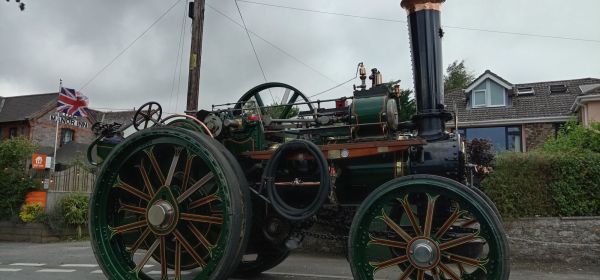
Indeed, what Goldsworthy Gurney first envisioned as an “Automobile” to be driven on open roads – became widely known as a “Traction Engine” from around 1850 in the UK. Ironically, whilst carry a single driver on country roads – whilst moving between farming fields – these devices were not allowed to evolve into the Motor Car envisioned by Goldsworthy Gurney. Only much later would a petrol-driven motor car be allowed to be developed. Whilst driving back from Exeter to Galmpton on Friday evening (Friday, August 1st, 2024) – whilst traversing the narrow streets of Galmpton – we encountered the above “Traction Engine” which was apparently joining many other examples in a local fayre that was about to be held! How lucky we were!

This combo photo taken on June 13, 2024 shows three inscribed boards, all written and bestowed by emperors of the Qing Dynasty (1644-1911), to the Potala Palace (upper L) and two monasteries in southwest China's Xizang Autonomous Region. (Xinhua/Tenzin Nyida)

Xizang: Historical Archives Demonstrate China’s Clear Sovereignty Over Tibet Region! (15.7.2024)

As the result of Xizang’s largest land census in history, the inventory is an important document for the study of the possession of the production means under feudal serfdom. In the 129 years before the 1959 democratic reform, the government, aristocrats and monasteries used it as the basis for issues relating to land, serfs and mandatory labour.

“Contrary to what some Western countries claim, the inventory showed that the central government had complete sovereignty over the region a long time ago,” Rinchen Tenzin added.

Since the establishment of diplomatic relations between China and the United States, successive U.S. administrations have pursued the one-China policy, recognized Xizang as a part of China, and promised not to support separatist activities, said Zhang Shigao, director of the Institute of Contemporary Studies at the China Tibetology Research Center.

“However, in practice, the United States often treats these commitments with negligence and even blatantly violates them,” Zhang added. 

(Video reporters: Sonam Dekyi, Wu Sisi, Huang Zhiqi, Phurbu Tsering; Video editors: Jia Xiaotong, Wei Yin, Zheng Xin, Wang Han, Zhang Yichi)

Sutton: Visiting the Carshalton Water Tower! (24.9.2023)

As immense wealth was generated through the labour of the exploited masses (which involved the development of the Trans-Atlantic Slave Trade) a privileged middle-class developed – particularly after the English Civil Wars of the 1640s. This development saw the successful transference of the control of the ‘means of production’ (and political power) from the Aristocracy (the upper-class) to the Bourgeoisie (the middle-class) and with it the unleashing of tremendous creative force (a process magnified enormously by the ‘discovery’ of the Americas and the effective stealing of immense tracts of ‘free’ land and other resources)! Of course, the spread of British power and influence throughout other countries of the world – including Africa and Asia – opened all kinds of diverse markets which spread commodities to the four corners of the earth!

1 2