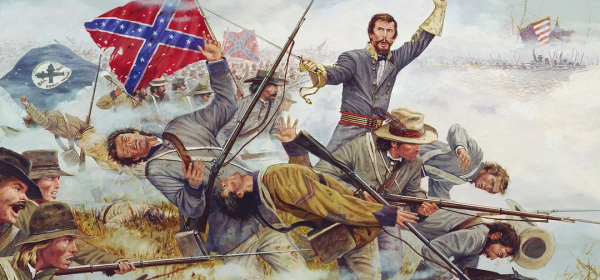
Major General Patrick R. Cleburne leading his men against Federal breastworks, Battle of Franklin, 30 November 1864!

CSA: The Magnificent Confederate Army of Tennessee Attack [30.11.1864] at the Battle of Franklin! (21.10.2025)

The Confederate Army had deployed in an almost Parade Ground formation… As far as the eye could see, the ranks of butternut and grey extended across the gently undulating farm-land. The men were gaunt, many looked like they had been starved – wrote a soldier – and they stood in tattered ranks with their bayonets already fixed on their imported Enfields, Austrians, and captured Springfield rifle-muskets. Their uniforms were threadbare and worn, with many wearing captured Federal clothing. Some had no coats or shoes, and in their haversack, they carried mostly sugarcane and hickory nuts. Nearly all were ragged and dirty. They looked more like a band of robbers than soldiers thought one Federal Private – who saw some captured prisoners. Another Union soldier noted that the Rebels ‘rob our dead because they have nothing to wear – especially for our shoes and coats. They still retained their droopy-felt hats – which gives them a hasty look.’  They are all that the Confederacy could muster – what was left of the hardened spirit of the middle-South. Yet their ragged appearance belied their ultimate worth.

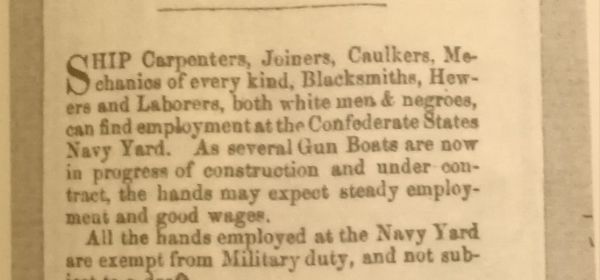
CSA Flyer Calling for Naval Volunteers!

CSA: Confederate Navy – Black & Foreign Workers! (15.10.2025)

The CSA Navy was primarily tasked with defending the waterways leading from the coastal areas (and the open sea) into the Southern hinterland from attack by the Union. The secondary mission was to venture out into the coastal areas and the open sea to attack any approaching Union ship. The problem with this latter requirement is that once CSA ships were drawn away from the protection of CSA estuary and coastal batteries – the Confederate ships were often sitting ducks. This being the case, and given that stocks of new iron were low, the secondary objective was only rarely exercised. Of course, Confederate submarines did do some surprising damage to Union shipping – but this technology was still new, quite often unreliable, and usually deadly to its own crew. Despite being side-lined in favour of the CSA Army – the CSA Navy (and those who administered it) did an extraordinarily good job against incredible odds. African-Americans, both free and still in slavery, assisted the CSA in its naval requirements.

Volunteers Fought At Harrisburg!

CSA: The Peculiar [1863] Union Defence of Harrisburg! (17.5.2025)

At one-point a thousand White volunteers from Harrisburg joined a large group of Black people to dig trenches and build ramparts around the geographical extremities. After one day, 700 of the White people returned home – saying the labour “hurt their hands” – whilst the other 300 acted as foremen directing the Black labourers (as if they were slaves). Black people built the defences of Harrisburg – but by and large were excluded from defending the place on the grounds that Black men carrying guns (and acting “free”) would scare the women and children. The situation was a little more nuanced than this, however, as NO White person from Harrisburg possessed the courage to join a local militia to defend the place they lived in. This led to the local authorities agreeing to arm a small company of local Black men that everyone knew – who had to drill away from the sight of ordinary people from Harrisburg. Meanwhile, thousands of White volunteers poured into the area to offer their services in defence of the place (risking their lives) – but were met with indifference and hostilities from the locals. Shop-keepers, hoteliers, and bar-owners put up their prices by ten or twenty times (even charging for a glass of water) – asking for excessive amounts of money for the smallest necessity of life.

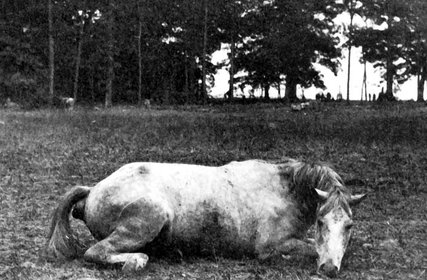
Library of Congress“Dead Horse of Confederate Colonel; both killed at Battle of Antietam,” by Alexander Gardner

CSA: Piles of Thread-Bare Confederates at Antietam [Sharpsburg] – Notes on Their Sacrifice! (31.1.2025)

The Union Army paid the farmer $1 per dead Confederate body and the farmer made $60 out of the deal. He dug a new well in a different place for the cost of $2 – making a wartime profit of $58. No one knows the names of these Confederate soldiers – and if it was not for a report being made by the Union soldiers concerned – no one would know about these men today. Of course, there was great bravery on both sides – but the spin placed on the war by the winners has skewed how the Confederacy is viewed today. These Confederate men (and boys) advanced into the Union fire with the utmost discipline and determination. They believed 100% in their cause – which was for the freedom of their individual countries (termed “States”). At the time, this war was not only about slavery – but has been made ONLY about slavery since 1865. Many believed the federalisation of the United States was a betrayal of the 1776 War of Independence – and nothing short of a great evil!

Southern Men Arise!

How Great Britain Assisted the Formation of the Confederate Post Office [1861-1863]! (8.1.2025)

The internationally-known London, England printing firm of “Thomas De La Rue & Co.”, prepared plates and stamps for the CSA until a Southern firm was found to take over the work. That firm, Archer & Daly, began producing stamps in 1863. The US blockade of as many Confederate ports as possible often meant that British ships carrying supplies from London, the UK, or the British Empire to the Confederacy – were often intercepted via acts of piracy on the high seas by the US Navy – with the goods confiscated and/or destroyed. The US government was continuously irritated by the continuous (undeclared) British support for the Confederacy – which for at least two-years extended into the realms of Post Office support! Of course, many of the best weapons the Confederate Army possessed were supplied by the UK. The Postmaster General of the Confederate Post Office Department (POD) – John Reagan (whilst traveling with President Jefferson Davis) – was arrested on the 8th May 1865, and imprisoned at Fort Warren in Boston Harbor. Reagan was pardoned and released from prison almost two years later. Jefferson Davis “refused” a Pardon (on the grounds that he had done nothing wrong) – and was subsequently released anyway.

1 2 3