Market Overton - 17th Century Window!

Market Overton: 17th Century Window! (6.11.2025)

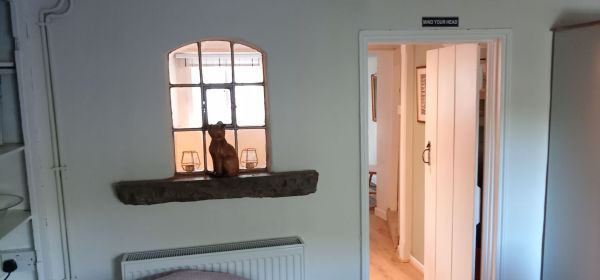
What is now the dining area – where I set-up my study space – was probably once part of the garden. Therefore, the window itself was once considered the height of building technology. In those days, draughts from blowing winds were a major issue. The frame of this window is firmly embedded in the wall-structure so that no wind can penetrate. The cement and plaster hold it robustly in place – whilst its relatively small surface area allows for strength and stability. As glass was not as strong then as it is now – the panes of glass used were far-smaller – with each held in-place by its own frame. Furthermore, and a feature I like, is the central pane that possesses a stout hinging and opening and shutting mechanism. Even today – this design still retains much of its original strength – whilst being now inside the house means it is now better preserved.
1600s Door-Frames Were a Tad Lower!

Rutland: Standing To Attention Was Abit Different in the 1600s! (27.10.2025)

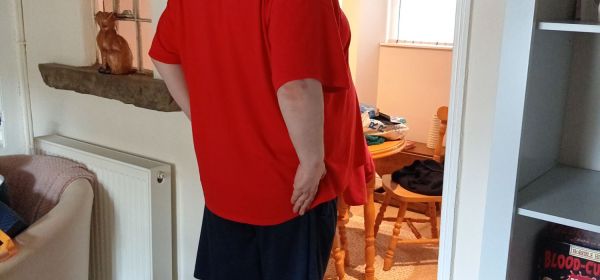
We are currently staying in a 17th century cottage in Market Overton. All the door-frames seem to be about 5’8″ high – if that. Blimey, if I volunteered for Cromwell’s forces, I would probably need a Shire Horse and a massive breast-plate! I am around 6’2″ tall and when I stand to attention – about a third of my head protrudes above and beyond the height of the average door-frame. I am always advising my two daughters to stand-up tall so that they grow to their full potential. Gee is 5’4″ tall – which is tall for a Chinese person who ancestors hail from South China.

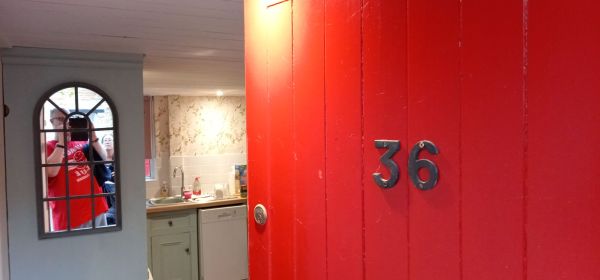
36 The Main Street - Market Overton - Rutland

Rutland: Teddy’s Cottage – Market Overton! (27.10.2025)

The above is extracted from the linked (historical) articled presented at the top of this article. I believe this information refers to the row of cottages – one of which – we are currently staying within for five-days. This is our current Research Headquarters for this visit (25.10.2025-30.10.2025) – where we will be travelling to and from Duddington (and the surrounding areas). In the information pack provided in the property – it states the house dates from the 17th century (1600s). It possesses two floor, two bedrooms, a downstairs living-room, dining-room, kitchen, and foyer. Much of the downstairs flooring is flagstone – with the floor levels from one room to the next being uneven (on different levels). Apparently, this has something to do with the age of the building.

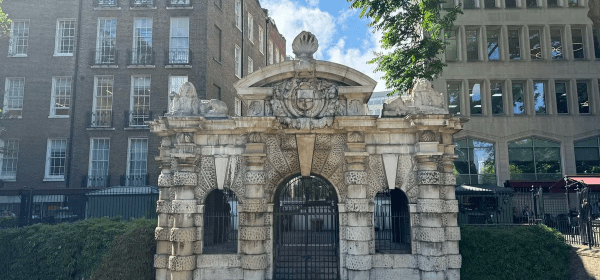
York Watergate - 1626 - Victoria Embankment!

UK: Beautiful London – the York Watergate Our Children Have Played Around! (7.7.2025)

The gate was originally the private riverside entrance to York House, a grand 17th-century mansion owned by the Duke of Buckingham. Think of it as a luxurious mooring point at the bottom of the duke’s garden.

York House itself stood on the Strand, which name literally means ‘shore of the river,’ and was considered one of the finest residences in London. At the time, much of the south side of the Strand was lined with palaces boasting direct access to the Thames.

That all changed with the construction of the Thames Embankment between 1864 and 1870, led by visionary engineer Sir Joseph Bazalgette. The massive project reclaimed land from the river and shifted the shoreline dramatically forward.

You can find a memorial honouring Sir Joseph Bazalgette just a couple of minutes away from Embankment Gardens, by the Thames. He designed the Victoria, Albert and Chelsea Embankments, reclaiming a strip of land in front of Somerset House and York Watergate.

The Watergate was almost lost during this transformation – plans were even drawn up to move it to nearby Whitehall Gardens. But in the end, it was simply abandoned where it stood, left behind as a relic of a river that had retreated.

Main Street - Forest Hill (Oxford) - OX33 1EB

Oxford: John Milton’s “Mounting Stone” – Forest Hill! (29.8.2024)

As to “why” Oxford Council resorted to this tactic is a matter of conjecture considering how overgrown the bank and stone is – and how difficult it is to actually locate the stone (there is virtually no signage). Perhaps a flat stone was becoming easily obscured by dirt, leaves and over debris – and an upright position rendered it better protected. John Milton (1608-1674) was a literary genius and esteemed poet who lived across the road from this stone and was a supporter of Parliament (and Oliver Cromwell) during the English Republic (1649-1660). His thinking was both progressive and Revolutionary! He (and his wife) were wealthy landowners in the area of the stone – owning property either side of St Nicholas Church in Forest Hill.

Alchemy: Phlogiston – A Retrospective! (10.4.2023) 

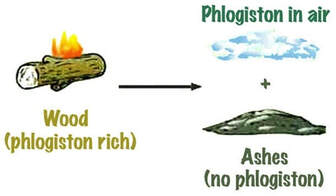
I think the theory of ‘Phlogiston’ was a good first effort and is certainly more realistic than suggesting that a disembodied theistic entity is controlling everything ‘from afar’ just as an act of arbitrary will! This theory even covered the human-breath – which was ‘hot’ because ‘Phlogiston’ was being ‘breathed-out’! If not enough ‘Phlogiston’ was breathed-out – then the human body would literally ‘burn-up’ and a fever would develop! Of course, modern Chemistry has replaced Alchemy and has long since washed away virtually all of the original foundation that once formed the bulwark of human logic in the face of theological domination. It is now understood that when substances ‘burn’ – nothing is ‘given-up’ – but rather a chemical reaction is experienced. Combustion is a chemical reaction that rapidly combines various substances with oxygen – generating heat and light in the form of a flame as a useful by-product. Whereas the ‘inverted’ thinking of religiosity was inadvertently retained through the theory of ‘Phlogiston’ (i.e., ‘something is lost’) – the non-inverted reality regarding the correct scientific interpretation of combustion – is that ‘something is gained’! This demonstrates just how powerful outdated or outmoded systems of thought are – even if it is believed that certain approaches to understanding reality have been firmly rejected and left in the past.