Einstein’s knowledge of Buddhism comes mainly from Schopenhauer. There is no evidence that Einstein understood Buddhism in its Asian cultural context, or through its broader philosophical implications.
Category: Buddhism
Exploring the philosophy (and practice) of Early and Later Buddhism.
Ch’an Buddhism as Scientific Socialism
If Buddhism is viewed as a ‘religion’ – and the Buddha as a ‘theistic’ being – then Buddhism has nothing to do with modern science,
Buddhism: Demystifying Ucchedavada Materialism
‘..the recluse Gotama is a Materialist, who teaches a doctrine of Materialism and trains his disciples in it.’
Two Interpretations of the Buddha’s Middle Way (Majjhima Patipada)
From 1931 to 1945, Master Xu Yun witnessed the barbaric behaviour of invading Japanese troops in China, and he associated this barbarism with Japan’s abandonment of the Vinaya Discipline.
Buddhism: Karma, Dukkha and Dependent Origination Contextualised
The Buddha defined the tiniest specks of matter (paramanu) [synonymous with ‘atoms’] to be occupying (and moving about within) time and space, whilst flickering in and out of existence. This is how the Buddha redefines matter (rupa) as being both ‘existant’, and ‘insubstantial’ (or non-existant).
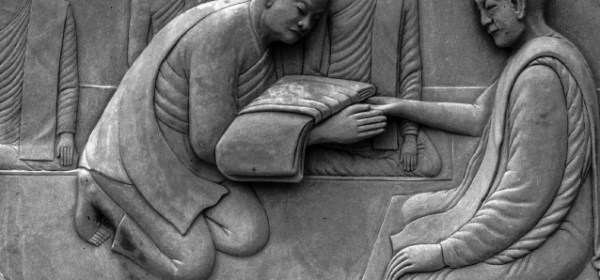
Buddhism: Pali Bhavana and Chinese Ch’an
Chinese transliterations and translations are useful as the early Chinese scholars had to understand the Indian Pali and Sanskrit terms before they could be rendered effectively into the Chinese language. Obviously, some of the early transliteration of Indian Buddhist terms are purely ‘phonetic’ in nature and in themselves do not convey much meaning as ideograms. This represents an initial process of a slow, careful and gradual building-up of knowledge in China about a thoroughly ‘foreign’ Indian philosophy that had to develop an ‘interface’ with existing Chinese culture.
 SANGHA KOMMUNE (SSR)