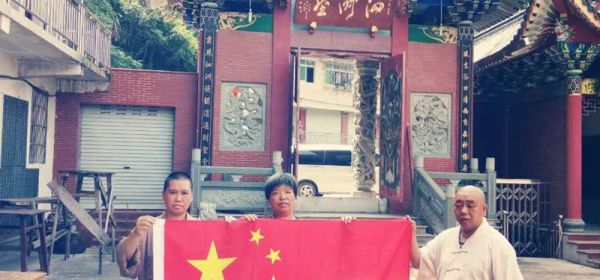
Original Chinese Language Article By: China Qingtian Net (Translated by Adrian Chan-Wyles PhD) On July 24, 2018, under the unified administration of the Qingtian County
Proletariat Blogging in the Heart of (UK) Predatory Capitalism! Exploring the Interface between Matter and Perception, Chinese Buddhism, Daoism, Hakka Ethnography, and All Aspects of Radical Politics, History, Psychology and Philosophy – 全世界无产者联合起来!
Original Chinese Language Article By: China Qingtian Net (Translated by Adrian Chan-Wyles PhD) On July 24, 2018, under the unified administration of the Qingtian County
READ ARTICLE HERE: Communism as Bodhisattva Activity Although in the West Buddhism has been hijacked and distorted by a capitalist, bourgeois agenda, in large parts
Within modern (material) science, empty space is defined as the measurable distance between two objects. This is correct and an undeniable fact. Of course, for
BMA (UK) Mainsite When the Buddhism – Marxism (UK) online presence was founded in Oxford on the 20th of July, 2013 (by the Oxford Collective
Patriarchal Ch’an, as I have experienced it, refers to the method of realising the empty mind ground here and now, and integrating this realisation with

Having suffered a stroke in 1996, Jill Bolte Taylor – a neuroscientist – rebuilt her brain functionality through the use of a detached observation of
 SANGHA KOMMUNE (SSR)