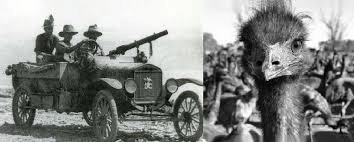
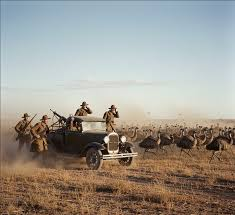
There is a side-ways link between the 1879 defeat of the British Army at Islandlwana (by the mighty Zulu) and the 1932 defeat of the Australian Army in the Outback (by the Emu) – as both involved large, flightless birds! The attire of the Zulu Army involved ostrich feathers for the King (and the higher ranks of nobility – as did many Zulu warriors from prominent regiments or impi) – whilst the machine guns of the Australian Army were outwitted and outmanoeuvred by an (unarmed) force of 20,000 of highly mobile Emus. It is said that during the drought of November, 1932, a huge Emu Army of 20,000 birds was on the march over the Australian countryside – looking for food and water. This brought the Emus into conflict with the Australian farmers – many of them WWI Veterans – who called for the use of “machine guns” to mow-down thousands of Emus and prevent them devastating the farms and destroying the crops. On November 2nd 1932, Major GPW Meredith of the Royal Australian Artillery, together with two soldiers (in a truck), was dispatched with two (Lewis) machine guns and 10,000 rounds of ammunition to address the Emu problem (the battle would last until December 10th 1932). The Emu Army suffered around 986 killed in action – (with numbers of wounded unknown) over a time-period of one month, one week, and one day. Considering the Emus were unarmed and lacked the intellectual ability to foresee their impending doom – these losses are considered “minimal” and something of a strageic defeat for the Australian Army. Yes – the Emu Army, by employing only the advantageous bestowed upon them by evolution through natural selection – it is often believed that the Emu Army inflicted a strategic defeat on the Australians! As the bullets came pouring-in – the massed Emus “scattered” in all directions and ran into the outback where their human pursuers could not venture.
 SANGHA KOMMUNE (SSR)