Blogger’s Note: The original article (reproduced here and referenced below) states:
‘In 1826, Godillot had another bright idea – developing a lightweight case with a hinged iron frame and a carpet covering. He had conceived it as being ideal for hunting and fishing – since these activities required lots of equipment but were too rugged for traditional trunks.‘
As Alexis Godillot was born in 1816 – it is unlikely that he would have invented the Attaché Case in 1826 aged just “10-years old”! In fact, evidence suggests that Alexis Godillot invented the Attaché Case around 1843 – when Godillot was aged around the much more probable 27-years old. The problem with this history is that sources state that Godillot founded a luggage firm (with his son) in 1843 – but if this was the case – his son could not have been older than 9-10-years old! What follows is essentially an informative advertisement – which I do NOT endorse. It is merely a convenient (but flawed) vehicle that conveys the fascinating history of the French inventor – Alexis Godillot! ACW (29.10.2023)
Chances are you’ve heard of the attaché case – but might not be entirely sure what is. Yet in reality, you’re probably much more familiar with the attaché than you realise. In fact, when you picture a briefcase, you are probably conjuring an image of the time-honoured attaché case. Let us explain.
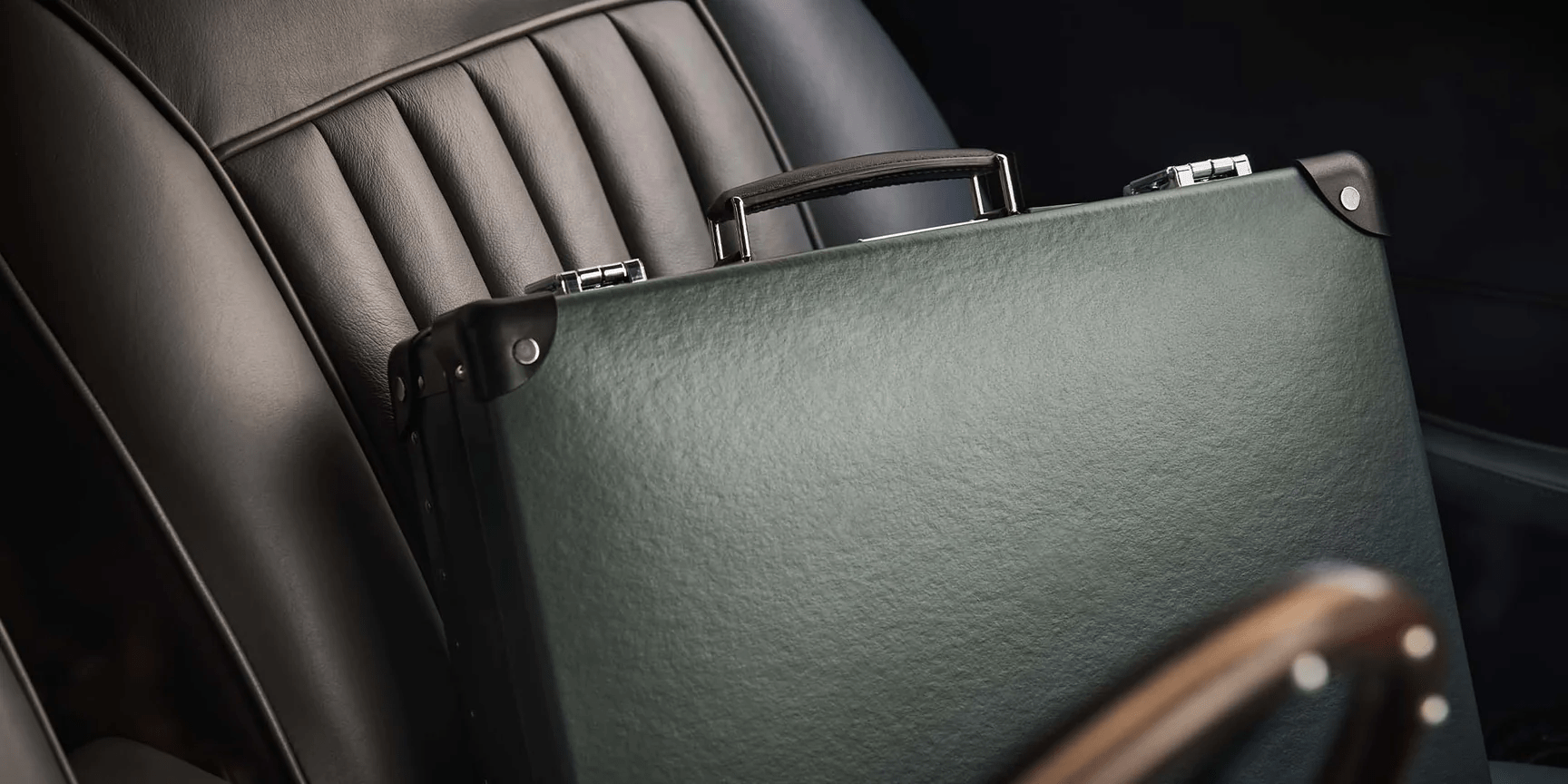
At heart, an attaché is a simple rectangular case – featuring a top handle, and a hinge on the opposite side which allows the case to open into two compartments. Since attaché cases are comprised of a steel or wooden frame covered in stiff leather, they are rigid in construction.
Since attaché cases were originally designed to carry A3 paper, they tend to be fairly uniform in terms of size: around 18” x 12” x 4”, large enough to carry a stack of A3 sheets. Most attaché cases will have an internal lining made of fabric or leather, as well as a document pouch or folio that can act as a divider. Likewise, attaché cases usually feature two top locks – which open via key or combination.
What’s more, attaché cases typically feature metal feet or some kind of corner moulding to ensure there is minimal damage to the leather when cases are left to rest on the ground.

Little known to most, the attaché’s first forefather was probably the Roman ‘loculus’ – literally translating to ‘little place’ – a satchel-style bag typically made out of goat hide or calf leather.
Unsurprisingly, satchel-style bags have a history stretching back thousands of years and have long been crucial as a means of carrying small items, especially since the pocket is a fairly recent invention – not seen before the 17th century.
That said, by the 19th century, luggage had changed a little. Travel was now the preserve of the elite and the heavy trunk the bag of choice, carried exclusively by a bagman or porter. No discerning gentleman would dare be seen lifting his own luggage. Meanwhile, the rest of society was left to make do with the pocket. Alexis Godillot spotted a gap in the market.
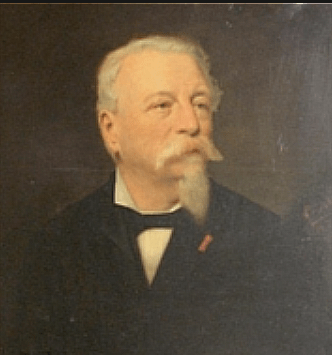
Rising from humble origins, Godillot is one of the modern world’s more impactful inventors. Indeed, it was he who pioneered the modern military boot, as well as the left and right shoe. (That’s right, for thousands of years until Godillot came around, pairs were effectively identical).
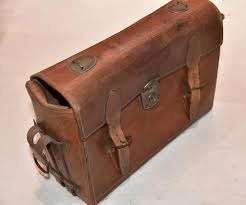
In 1826, Godillot had another bright idea – developing a lightweight case with a hinged iron frame and a carpet covering. He had conceived it as being ideal for hunting and fishing – since these activities required lots of equipment but were too rugged for traditional trunks. (The dating cannot be correct – see ‘Blogger’s Note’ above).
That said, Godillot was so pleased with his new invention that he began carrying it everywhere he went. His trailblazing case caught the eye of many across Paris and before long, the attaché case (as it is now known) found its home in a more metropolitan setting.
For all this talk of attachés, in Britain at least, we’re much more familiar with the term briefcase. So what exactly is the difference between an attaché case and a briefcase?
The history of briefcases can be traced back to the Gladstone bag – conceived by J.G. Beard, in response to the four-time Prime Minister’s liberal policies. Gladstone had made travel more attainable for the average Briton – Beard’s bag built on Godillot’s principles, but replaced carpet with stiff leather.
Around the same time, Jeremy Stenning developed a box-like case – much like the Gladstone, but instead, built around a frame. This mechanism allowed the bag to fully open, making it much easier to identify documents. As such, the bags became popular for lawyers carrying ‘briefs’ – hence the name, briefcase.
Since lawyers were constantly signing documents, they needed these cases to act like portable offices. Briefcases quickly grew to include multiple compartments, suitable for storing ink, spare paper and stationery.
While the terms are often used interchangeably, strictly speaking, a briefcase denotes any case used for storing briefs or documents. An attaché case specifically refers to the hinged rectangular configuration which opens into two compartments.
So, an attaché is by very nature a briefcase – but a briefcase is not necessarily an attaché. Other popular styles of briefcase include the portfolio, the messenger bag and the travel briefcase. Some might even argue that the modern backpack is technically a briefcase. Still, the attaché is undoubtedly the most famous model – what 99 per cent of people envisage when they hear the term briefcase.
Original English Language Artickle:
 SANGHA KOMMUNE (SSR)