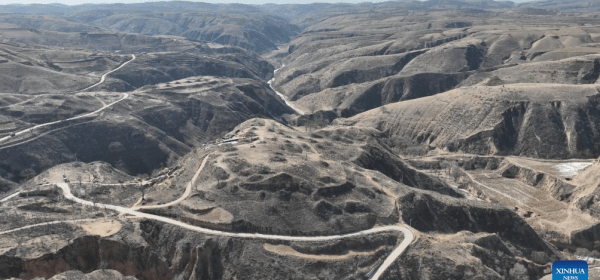
This file photo shows ancient stone fortresses in Yulin, northwest China's Shaanxi Province. (Photo by cultural heritage and archaeology team of the city of Yulin/Xinhua)

China: Survey Team Discovers 573 Ancient Stone Fortresses in North-West! (13.11.2025)

The survey revealed that these settlements spanned from about 2800 BC in the late Yangshao period to around 1000 BC in the Shang and Zhou (1046-221 BC) dynasties.

Mostly distributed along riverbanks, the stone fortresses were surrounded by numerous ordinary settlements without defensive stone walls, indicating a clear clustered relationship, said Ma Mingzhi, head of the team.

The development of these stone fortresses shows a clear evolution from small to large in scale, from simple to complex in layout, and from rudimentary to mature in construction techniques — with social hierarchy becoming increasingly distinct.

The survey provides crucial information for a comprehensive understanding of the origin, development, spread and evolution of prehistoric settlements in northern China, Ma added.

Ancient Chinese Canoe!

Ancient China: 5000 BCE Neolithic Boat Discovered at Hemudu, [Yuyao] Zhejiang! (13.3.2024)

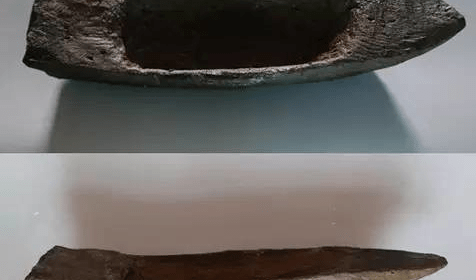
From grasping usurping natural floating objects (such as people straddling a tree trunk or holding a gourd as a means of crossing a body of water) to waist-floats (perhaps several gourds tied together with ropes to increase the buoyancy of the mid-riff) to rafts (flat and wide buoyant objects tied together to increase the buoyancy – enough to bear the weight of a person whilst floating across the water). The emergence of rafts was a clear sign of a great technological leap forward for humanity which removed a traveller getting wet and actively creating proper water vehicles. Later, with the help of stone axes and fire (according to Friedrich Engels), a “boat” (as a “Canoe”) was made from a whole piece of wood. An example of this is pictured above which stems from the 7,000-year-old (c. 5000 BCE) Neolithic ruins discovered at Hemudu, Yuyao, situated in Zhejiang.

Archery as an Ancient Art!

Daoism: Archery in the Central Plains! (5.3.2024)

Indeed, as a distinct body of rituals – Confucianism is older – with Daoism developing later. The problem is that historical elements of both ideologies exist within China’s early history. These elements eventually diversified into specific and distinct schools of thought – that seem ‘different’ in practice (which they are) – whilst sharing similar or identical concepts. Term ‘道’ (Dao) exists in Confucian thought as well as in the musings of Laozi and Zhuangzi! Above is my short research paper on the ‘中’ (zhong1) ideogram in relation to archery and ‘hitting the target’.

Flora Botton (Mexico): Why Ancient & Modern China Should Be Understood as a Completed Whole! (2.10.2023)

Flora Botton: Mexico and China have established diplomatic relations for more than 50 years. I am happy to say that Mexico and China have a lot of communication in all aspects, whether it is economic relations, political relations, or academic relations. Exchange students, scholarship establishment, visiting scholars, travel, language learning… all kinds of communications.

In ancient times, “sinologists” were scholars who spread Chinese culture by learning and translating Chinese. They specialized in the study of traditional Chinese culture. And now the term is widely used for any scholar who studies China, even contemporary China.

1 2