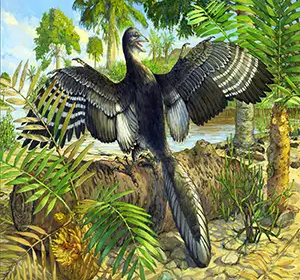
Illustration showing Archaeopteryx in life, including its tertial feathers that would have helped it fly. Credit: Michael Rothman. Click image to enlarge.

US: Ongoing Analysis of – Archaeopteryx Fossil – Continues to Proves Darwin Right! (21.3.2026)

Differences in modern birds

Modern birds evolved shorter upper arm bones and specialized tertial feathers to close this gap.

Remarkably, the Chicago specimen of Archaeopteryx shows it had long tertial feathers too – something unseen in its flightless dinosaur relatives.

“Our specimen is the first Archaeopteryx that was preserved and prepared in such a way that we can see its long tertial feathers,” she noted.

These feathers, absent in closely related non-avian dinosaurs, suggest those creatures couldn’t fly.

“That tells us… Archaeopteryx could,” O’Connor added. “This also adds to evidence that suggests dinosaurs evolved flight more than once – which I think is super exciting.”
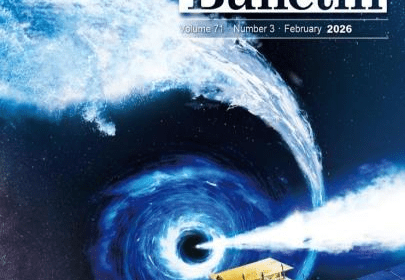

Cover of the journal that published the study. (Photo courtesy of the Einstein Probe Science Center of the National Astronomical Observatories)

China: Chinese Scientists Report First Likely Sighting of Black-Hole Devouring White Dwarf! (12.2.2026)

Chinese astronomers said they have likely captured the first direct evidence of a mid-sized black hole ripping apart and consuming a white dwarf star, shedding new light on a long-theorized but rarely observed cosmic process.

The discovery is based on observations of a powerful high-energy space explosion known as EP250702a, detected by China’s Einstein Probe satellite, according to the National Astronomical Observatories of the Chinese Academy of Sciences. The findings were published this month in the journal Science Bulletin.

Mid-sized black holes, thought to bridge the gap between stellar-mass and supermassive black holes, are difficult to detect because they produce few observable signals unless actively feeding on nearby matter.