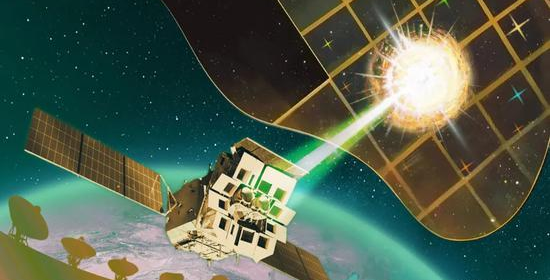
Many experts at home and abroad said that the observation results of EP240315a by the EP satellite have deepened humanity’s understanding of early universe gamma-ray bursts, offer fresh insights into the origins and evolution of the universe, Xinhua reported.
The EP mission is one of a series of space science missions led by CAS. This is an international collaboration effort, featuring contributions from the European Space Agency (ESA), the Max Planck Institute for Extra-terrestrial Physics (MPE) in Germany, and the French space agency CNES.
Launched into space in January 2024, the satellite has achieved several initial discoveries, such as an uncommon transient phenomenon, advancing understanding of the universe and extreme physical phenomena, Xinhua reported.
![The wide-field X-ray telescope on the EP satellite detected over 6,800 X-ray sources distributed across the celestial sphere (under Galactic coordinates). [Photo provided to chinadaily.com.cn]](https://thesanghakommune.org/wp-content/uploads/2024/11/image-1.png?w=600&h=280&crop=1)
 SANGHA KOMMUNE (SSR)