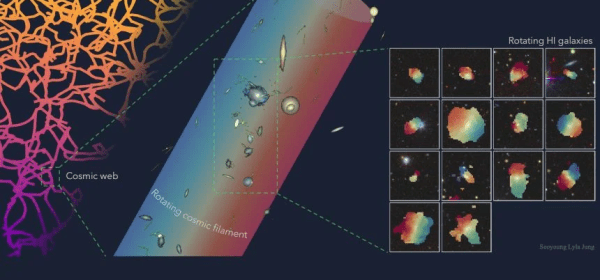
A figure illustrating the rotation of neutral hydrogen (right) in galaxies residing in an extended filament (middle), where the galaxies exhibit a coherent bulk rotational motion tracing the large-scale cosmic web (left). Credit: Lyla Jung

Oxford: Astronomers Spot One of the Largest Spinning Structures Ever Found in the Universe! (6.12.2025)

Professor Jarvis said: ‘This really demonstrates the power of combining data from different observatories to obtain greater insights into how large structures and galaxies form in the Universe. Such studies can only be achieved by large groups with diverse skillsets, and in this case, it was really made possible by winning an ERC Advanced Grant/UKIR Frontiers Research Grant, which funded the co-lead authors.’

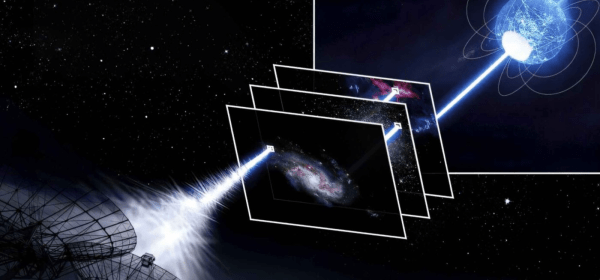
reached Earth after traveling 10 billion years through space

Space: Fast Radio Burst [FRB] Reaches Earth After Travelling 10 Billion Years! (23.9.2025)

Why cosmic noon matters

The burst came from a time nicknamed “cosmic noon,” when the universe was forming stars at its fastest rate.

Astronomers see a peak in the cosmic star formation history about 10 to 11 billion years ago, and this event sits in that era.

Finding an FRB there matters for more than a date on a timeline. It shows that whatever powers FRBs was active when young galaxies were busy building their stars.

“This discovery doubles the redshift reach of localized FRBs. Our observations establish FRB activity during the peak of cosmic star formation” wrote Caleb.

Socialist Science Triumphs!

China: Socialist Light Shone on “Big Bang”! (26.1.2025)

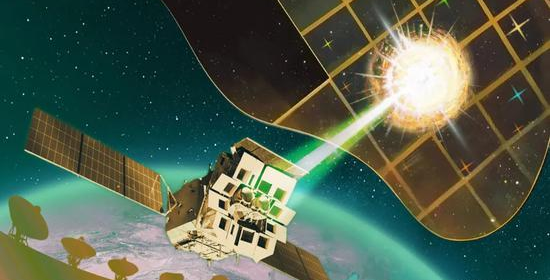
Many experts at home and abroad said that the observation results of EP240315a by the EP satellite have deepened humanity’s understanding of early universe gamma-ray bursts, offer fresh insights into the origins and evolution of the universe, Xinhua reported.

The EP mission is one of a series of space science missions led by CAS. This is an international collaboration effort, featuring contributions from the European Space Agency (ESA), the Max Planck Institute for Extra-terrestrial Physics (MPE) in Germany, and the French space agency CNES.

Launched into space in January 2024, the satellite has achieved several initial discoveries, such as an uncommon transient phenomenon, advancing understanding of the universe and extreme physical phenomena, Xinhua reported.

Magnetic Pulse - Chirp - 2025

China: Joint Research Team – Unexpected “Chirping Chorus” Detected from Outer Space! (23.1.2025)

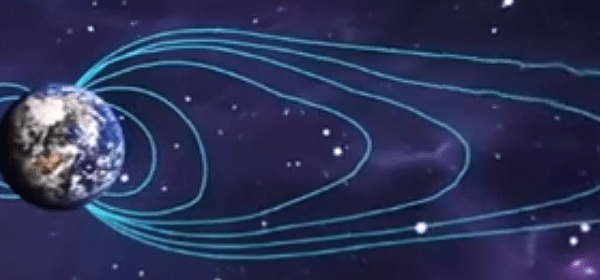
According to the research team, electromagnetic bursts play a crucial role in the formation of the Earth’s radiation belts, pulsating auroras, and the precipitation of particles into its atmosphere. Traditional views hold that chorus waves are formed in the magnetic field of a dipole of near-Earth space, where the magnetic field is similar to a large bar magnet.

The newly-found chorus waves were detected in a region where Earth’s magnetic field is stretched out, which scientists didn’t expect. They lasted about 0.1 second with a frequency of nearly 100 hertz per second, which are similar to the waves detected in near-Earth space. That raises fresh questions about how these chirping waves form.

China Manned Space Agency (CMSA)

China: Logos Unveiled for 3 “Socialist” Space Missions in 2025! (20.1.2025)

According to the CMSA, crews for the Shenzhou-20 and Shenzhou-21 missions will consist of three astronauts each. Shenzhou-20 is set to dock with the radial port of the space station’s core module, while Shenzhou-21 will dock with its front port.

The main tasks of the astronauts will include extravehicular activities, cargo outbound deliveries via the station’s cargo airlock module, and the conducting of space science experiments and technology tests.

In the second half of 2025, China plans to launch the Tianzhou-9 cargo spacecraft from the Wenchang Space Launch Site in its southern Hainan Province. This mission will deliver supplies for astronauts, propellants to ensure the space station’s operation, various types of payloads, and more.

China’s manned space station project has entered its application and development stage — with two manned spacecraft missions and one to two cargo missions planned annually.

The wide-field X-ray telescope on the EP satellite detected over 6,800 X-ray sources distributed across the celestial sphere (under Galactic coordinates). [Photo provided to chinadaily.com.cn]

China: Tian Guan [天关] “Einstein” Probe Detects Mysterious Celestial Object [EP240408a]! (1.11.2024)

In addition to detecting individual events, the EP has conducted repeated sky surveys, successfully generating China’s first all-sky X-ray map. Yuan said the satellite contributes data that represents over 30 percent of all information available on global platforms for the study of transient and eruptive phenomena.

The EP team annually solicits research proposals from Chinese scientists and provides data access to international researchers one year after acquisition.

China’s recorded interest in transient phenomena dates back to the Han Dynasty (202 BC-220 AD). In 1054, astronomers from the Song Dynasty (960-1279) documented the “Guest Star of Tian Guan,” later known as the Chinese Nova, a supernova explosion considered among the most significant astronomical observations in history.

Yuan said the Einstein Probe, known as Tian Guan in Chinese, honours this legacy and seeks to inspire future contributions to world astronomy.

1 2 3