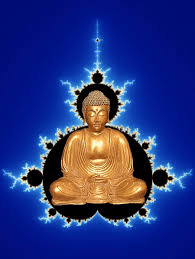
Mandelbrot Buddha!

Sunyata: The Beautiful Emptiness! (9.2.2012)

‘To understand this developmental process, an assessment of ‘emptiness’ (sunyata) must be undertaken. It is clear that in early Buddhism emptiness refers to the lack of the presence of greed, hatred and delusion, as well the abandonment of the notion of a permanent self. It is an emptiness that marks the absence of delusion. Delusion is no longer present in the mind or perceived in the environment (in relation to the mind). The mind does not create the conditions that lead to the desire of external entities or attachment to those entities. It is true that no further karma is produced but that the karma relating to the world and the physical body continues until it is fully burnt off (at the point of death), and there is no more re-birth. The nirvanic state has present within it certain powers of the mind, and perfected knowledge. This concept of nirvana exists as an escape from the physical world of samsara. It is viewed very much as an antidote to the suffering experienced within ordinary life.’
Buddhism Through The Capitalist Filter.

‘For many, modern living carries the necessity for mutual exploitation of one another either within, or in the case of crime, outside a moderating legal system. Profit has to exist for the system to function, and with this profit, there must be inequality. The Buddha lived in a society that privileged his caste and his social rank – his father was a chief or king (raja). Social inequality was as prominent in ancientIndiaas it is today across the world. As a spiritual statement, the Buddha gave up his life of luxury, his wife and his child. He turned his back on a life of sensual pleasure and headed into the wilderness to rid his mind of attachment.’

The Buddha’s Enlightenment.

‘Through austerity and meditation, and after leaving the world of plenty, the Buddha roamed from place to place with only his begging bowl and robe as possessions. After practicing austerity, he rejected this method as not being able to reach the highest enlightenment. He trained in, and fully mastered the meditative methods of his day, and despite achieving the highest state, rejected these paths as not going far enough toward the ultimate enlightenment. Having abandoned the conventional spiritual teachings, he embarked upon his own meditative practice, a practice that would eventually lead to a full and profound inner metamorphosis, more commonly known in English as ‘enlightenment’.’

Jhana: The Buddhist Search For Focused Equanimity.

‘The physical material of the universal itself is not necessarily morally corrupt as it exists, but rather is made so by a mind projecting a distorted meaning onto, and into it. However, as the karmic fruits of an individual actually ‘pull’ a physical world into place, even morally inert matter is designed, through circumstance, to create experiences relevant to the karmic root actions themselves. Early Buddhism envisages 31 such states of existence that are only transcended through the experience of enlightenment at the point of the death of the last karmically inspired physical existence. Until that time, the mind appears to ‘burn’ with sensation and obsessive thought patterns that inspire actions that inevitably lead to further effects. This mechanism that sees the mind fabric intimately entwined with the physical world, has to be prevent from functioning in an unquestioned manner. The power of habit moves in one perpetuating direction, as like a piece of metal drawn to a strong magnet. Habitual tendencies appear ‘normal’ because they are familiar. Delusion is a comfortable state that ‘hurts’ those residing within it. The pain of delusion is never associated with the ‘delusion’ itself. The human will (cetana) is the Buddha’s key to suffering and its over-coming.’

The Transformative Psychology of Enlightenment.

‘Psychology in the West is a relatively new field of study. As such, there is no ‘one’ agreed approach to the theory of ‘mind’ in the Western tradition. Viewpoints vary from that of the neurologist, who views every attribute of human, conscious creativity as being nothing more than a mixture of chemical reactions and electrical impulses, to the psychotherapist, who works with the thought processes, so as to achieve a ‘balanced’ and culturally ‘agreed’ state of mind. Needless to say, virtually every other view of the mind fits somewhere inbetween these two broad perspectives. This dissertation will examine the many facets of the mind, as viewed from both the Western and Eastern traditions and the consequence of this combined knowledge for the modern and post-modern human condition.’

1 20 21 22