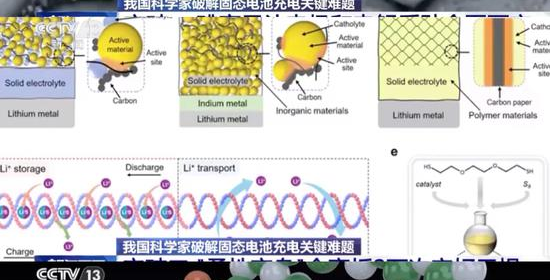
Chinese researchers announces a major advance in all-solid-state lithium battery technology. (Screenshot Photo)

China: Breakthrough in Solid-State Batteries Announced – Doubling NEV Range! (17.10.2025)

Chinese scientists have developed a self-adaptive interphase in all-solid-state lithium batteries that maintains intimate contact between the lithium metal anode and solid electrolyte without external pressure, a breakthrough that decisively overcomes a major bottleneck toward commercialization.

The researchers from the Institute of Physics of the Chinese Academy of Sciences (CAS), Ningbo Institute of Materials Technology and Engineering of the CAS and Huazhong University of Science and Technology found that the contact between the lithium electrode and sulfide solid electrolyte in all-solid-state lithium batteries is not ideal, with numerous tiny pores and cracks present. These issues not only shorten battery lifespan but may also pose safety risks.

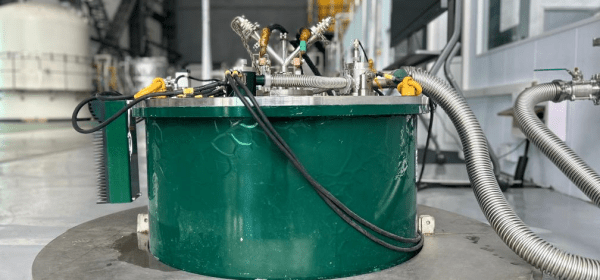
This photo taken on Sept. 28, 2025 shows the superconducting magnet developed by the Chinese Academy of Sciences' Institute of Plasma Physics (ASIPP) in Hefei, east China's Anhui Province. (Xinhua/Wu Huijun)

China: Scientists Set World Record with Magnetic Field 700,000 Times that of Earth! (28.9.2025)

It also provides crucial technical support for multiple cutting-edge fields, including fusion magnet systems, space electromagnetic propulsion, superconducting induction heating, magnetic levitation, and efficient power transmission.

The magnet was developed by the Chinese Academy of Sciences’ Institute of Plasma Physics (ASIPP), located in Hefei, east China’s Anhui Province, in collaboration with the Hefei International Applied Superconductivity Centre, the Institute of Energy of the Hefei Comprehensive National Science Center, and Tsinghua University.

Earth itself is a giant magnet, generating a geomagnetic field of about 0.5 gauss. Superconducting magnets, fabricated by winding superconducting materials, can generate extremely strong magnetic fields while enabling lossless transmission of large currents.

All 56 Ethnicities in China Are "Equal" in Law!

China: Socialist “Internationalism” Triumphs! (17.6.2024)

In an article by Xi, who is also general secretary of the Communist Party of China Central Committee and chairman of the Central Military Commission, that was published in January in Qiushi Journal, the flagship magazine of the CPC Central Committee, he said that forging a strong sense of community for the Chinese nation is to guide people of all ethnic groups to uphold the vision of a community with a shared future by standing together through thick and thin.

“Ethnicity is the concept in terms of language and culture, and the Chinese nation is the political entity that all Chinese people belong to, no matter which ethnic group they are from,” Pan said.

By enhanced extensive exchanges and interactions during the past 10 years, people from different ethnic groups in China have learned more about one another and become more united, which has brought stability and prosperity to the country, he added.

Computer Interface with Brain!

China: Brain-Computer Interface Assists Paralyzed Patients Regain Mobility! (8.3.2024)

Another 35-year-old paralyzed patient underwent surgery in December 2023 and can control cursor movements with his mind after two months rehabilitation.

The implantable device, called Neural Electronic Opportunity (NEO) is about the size of a coin and employs near-field wireless power supply and signal transmission, thus making the internal machine implanted in the skull battery-free, expert introduced.

Experts explained that brain-computer interfaces are divided into three categories: non-invasive, invasive and semi-invasive. The minimally invasive, wireless brain-machine interface project initiated by Tsinghua University will not damage brain tissue, averting inflammation, scarring and other adverse conditions.

PRC: Mainland Student Group Arrives in Taiwan Region! (17.7.2023)

The trip is scheduled to include stops in Taipei, Taichung, New Taipei, Hsinchu and Hualien.

On Saturday evening, Ma Ying-jeou held a dinner reception to welcome the group. He said the visit is the most important event to boost exchanges between young people on both sides in recent years.

He also expressed his hope that cross-Strait tensions could be eased and cross-Strait exchanges fully resumed to benefit people on both sides.

Between late March and early April this year, Ma took a group of Taiwan students to the mainland and had discussions at three universities, during which he repeatedly expressed his hope that teachers and students from mainland universities could visit Taiwan on an exchange basis.