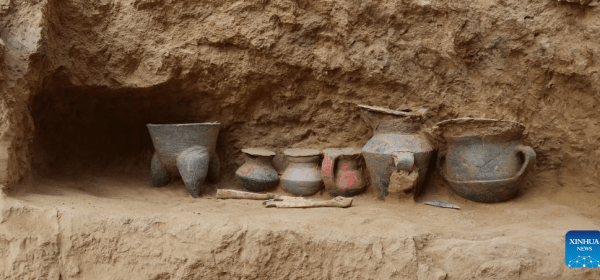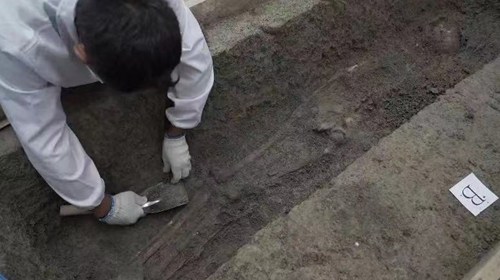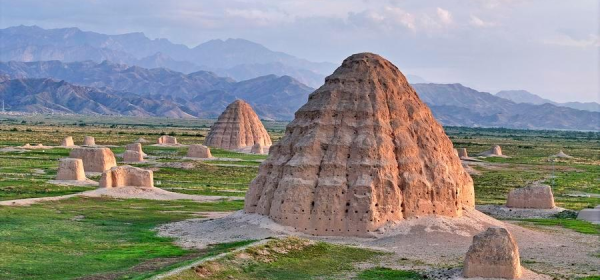
Artifacts unearthed from a tomb at the Shimao ruins in Yulin, northwest China's Shaanxi Province. (National Cultural Heritage Administration/Handout via Xinhua)

China: Ancient DNA Reveals Kinship & Social Structure of China’s Prehistoric Shimao City! (28.11.2025)

The research published on Thursday in Nature presents the first direct genetic evidence regarding the origins of the Shimao population — the builders of Shimao, a massive Neolithic walled settlement in northern China that thrived around 4,300 years ago and was abandoned about 500 years later.

The findings, based on genetic analysis of ancient individuals, offer a glimpse into the kinship practices, including sex-specific sacrificial rituals, of an early state-level society in East Asia.

The 4-million-square-metre Shimao city is the largest known prehistoric settlement in China. Its sophisticated fortifications, including pyramid-like platform, cyclopean stone walls, palatial complexes and stone carving, along with high-status artifacts like exquisite jades, point to a highly complex, stratified society.

Adrian the Monk - 2025

Report: Ghost Hunting in North Devon! (29.8.2025)

With most of the lights off by 11pm, I sat on my religious chair (the Church dates back to the 14th century – and so does the chair). I cleared my mind and immersed myself into the ancient nature of the stone-work. The stone was cool to the touch – I went bare-foot to ground myself – and felt the calm structure of the place. No fear, no deception, and nothing to worry about, Although I neither support or oppose theology – I sensed the spiritual feel that all the attendees developed and projected into rge physical structure of the place. In many places in the UK, the Christians deliberately built their Churches on already existing Pagan sites of ancient spirituality – with nothing to do with a Christian god. The mistake that Christians make is that their own mind creates the religion they believe in – but they mistakenly believe that their religion exists “outside” their heads, independent of the mind that generates it. The perception is inverted and the wrong way around.

Many Non-Han People Visited the Noth-West Region!

China: Ancient Silk Road Museum of Underground Tombs Complex – Opens in Xinjiang! (16.7.2024)

A large cache of pottery and bone ware and coins unearthed from the tombs are also on display in the museum.

“The museum makes full use of the original appearance of the tombs, as well as digital exhibition, VR technology and touch screens to offer the audience an immersive experience of the ancient Qiuci,” said Feng Wei, deputy curator of the museum.

According to the Xinjiang regional institute of cultural relics and archaeology, four excavation rounds were carried out from 2007 to 2023 at the site in Kuqa, which led to the discovery of more than 2,000 relic sites. In addition to the tombs, there are wells, cooking stoves and other relics dating from the Spring and Autumn Period (770-476 BC) up to the Ming and Qing dynasties (1368-1911).

China: Modern Archaeology Proves Historicity of Emperors Yao & Shun! (24.9.2023)

“If we can further testify ancient Pingyang existed through material proof, then the Chinese history of Yao and Shun would be changed from a legend to a real historical time,” archaeologist Xue Ruiming told the Global Times. 

Xue added that the tomb ruins show the site’s “historical continuity.” He also said that ancient sites around Linfen are not only known to have “rich pottery relics,” but also hold great archaeological significance. The Taosi site is another site in the city that has more than 4,000 years of history. 

Dating back 4,300 to 3,900 years ago, the Taosi site is a major archaeological spot that has been included in China’s national program dedicated to tracing the origin of Chinese civilization. Several notable relics, including a pottery plate decorated with dragon patterns was found at the site’s high-level tombs that once belong to local royalty. 

A large rammed earth building wa

China: 6,000-Year-Old “Male” DNA Found in Matriarchal Society! (24.9.2023)

According to experts, by comprehensively analyzing and comparing the environmental differences, living and production levels, artistic and aesthetic inheritance and human physical changes between then and now, the excavation has revealed that the human history of Wuxi dates back to at least 6,000 years ago. 

The relics and artifacts unearthed from the site have become “living fossils” of the matriarchal society in the area.

The Majiabang Culture was named after Majiabang village in Nanhu, East China’s Zhejiang Province, where it was first discovered in 1959. 

Archaeological surveys over the years have shown that the Majiabang Culture, a matriarchal society, was bridged by the Songze Culture before this area completely developed into a patrilineal society. After that it reached the threshold of state civilization after it combined with the Liangzhu Culture, a highly developed ancient culture in the late Neolithic Age in the Yangtze River Delta.

1 2