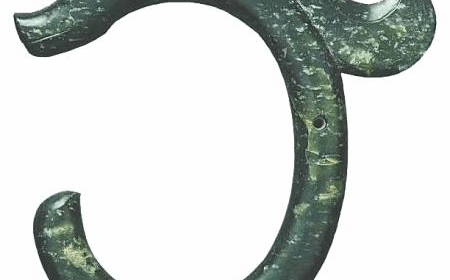
35000 BCE - Dragon

Qianfeng Daoism: Enter the Dragon! (9.2.2024)

Considering how important the concept of the ‘Dragon’ is throughout Chinese culture – I was surprised just how haphazard the construction of its representing ideogram actually is. As this is my area of academic expertise, I could not believe what I was looking at! Consequently, it took me three-days to disentangle the mess that this ideogram seems to have gotten itself into. Having achieved this objective – I then unloaded the finished article onto the Qianfeng Daoist website I help to administer.

China Space Station Steadily Enlarged Since Its Original Construction! (7.6.2023)

This brings us to the Tianzhou-5 cargo spacecraft, whose launching and docking with the station were witnessed in November last year, as well as its undocking in early May to leave its port for its successor. Currently, it is flying alongside the CSS and will dock with the station after the return of the Shenzhou-15 spacecraft.

These cargo ships have more critical tasks than being simple couriers for space cargo. For example, the Tianzhou-5 will provide propellants, solar power and waste storage for the station in the coming months.

The three-module and three-ship configuration will remain in place for nearly half a year until the Shenzhou-17 manned mission. Looking ahead, the CSS will expand with additional modules.

Russia: The Enigma of the Asiatic Giant Shigir Idol (Большой Шигирский идол) – Where Ancient Russians Really Seventeen-Feet Tall? (12.3.2023) 

I have heard a number of Slavic academics stating that they believe that some of the patterning on the exterior of the Great Shigir Idol constitutes a written ‘language’. If correct, this finding would constitute the world’s ‘oldest’ written language! I am not adverse to this idea and I believe such a suggestion requires further investigation! Based upon the mythology of the Ugrians, Natalia Chairkina sees in these images a reflection of a vertical model of the universe logically divided into the Upper, Middle and Lower worlds (similar to the ‘trigram’ and ‘hexagram’ of the Chinese book ‘Classic of Change’) – which accommodate seven spheres of empty space. Archaeologist Peter Van Petersen of the National Museum of Denmark has suggested that the idol may have served as a warning at the border of a forbidden territory to scare off invaders or undesirables – or to test the courage of an individual or group. A number of Archaeological experts also note the similarity of design with the monumental stone ruins in Göbekli Tepe in Turkey (which is of a similar age). As many of the marking are both difficult to see and ambiguous in design – it is currently very difficult to produce a definitive interpretation. The best policy is for everyone to ‘look’ at this remarkable structure themselves – and up their own mind. Conventional science has already proven its improbable age! Let’s follow Lenin’s example and sit in our kitchens and ‘think’ great thoughts!