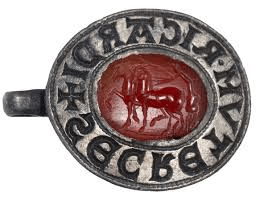
The finely-carved Roman gemstone shows a charioteer standing on a racing chariot, with whip in hand, urging on two high-stepping horses

England: Latin Medieval Seal – Reading “+SECRETVM . RICARDI” [with Roman Gem-Stone] Unearthed! (2.2.2026)

The inscription – which reads +SECRETVM . RICARDI – shows the seal was created specifically for a man called Richard.

He would have used it to make a mark in hot wax to seal his letters and documents.

Richard appears to have specifically chosen the carved gemstone, known as an intaglio – possibly as a way of showing he had an understanding of the Classical world, according to Miss Rogerson.

She said: “It definitely would have been an indicator of the owner’s social status as a way of saying, ‘I have the means of obtaining something from a far gone time and place’ and indicated they were quite important – or saw themselves as quite important.”

This file photo shows ancient stone fortresses in Yulin, northwest China's Shaanxi Province. (Photo by cultural heritage and archaeology team of the city of Yulin/Xinhua)

China: Survey Team Discovers 573 Ancient Stone Fortresses in North-West! (13.11.2025)

The survey revealed that these settlements spanned from about 2800 BC in the late Yangshao period to around 1000 BC in the Shang and Zhou (1046-221 BC) dynasties.

Mostly distributed along riverbanks, the stone fortresses were surrounded by numerous ordinary settlements without defensive stone walls, indicating a clear clustered relationship, said Ma Mingzhi, head of the team.

The development of these stone fortresses shows a clear evolution from small to large in scale, from simple to complex in layout, and from rudimentary to mature in construction techniques — with social hierarchy becoming increasingly distinct.

The survey provides crucial information for a comprehensive understanding of the origin, development, spread and evolution of prehistoric settlements in northern China, Ma added.

Diverse Collection of Stone Tools - Hainan!

China: 13,000 Year-Old Prehistoric Tomb Unearted in Hainan! (11.11.2025)

Archaeologists proved that the remains belong to a juvenile, with decorative textiles made from shells found near its head and waist – the earliest such findings ever reported in China – which offer rare insights into prehistoric cultural practices in Hainan and potential cultural exchanges with Southeast Asia.

Excavations at the Luobidong site are ongoing, trying to fully reveal the cultural significance of the site and provide a scientific foundation for both prehistoric research in Hainan and the development of the Luobidong National Archaeological Site Park.

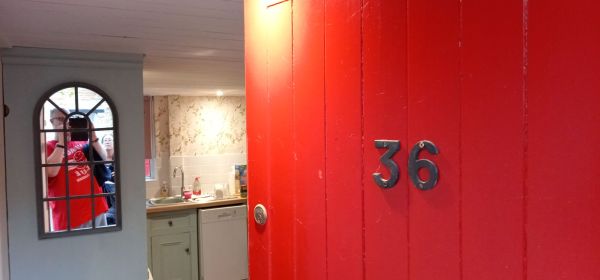
36 The Main Street - Market Overton - Rutland

Rutland: Teddy’s Cottage – Market Overton! (27.10.2025)

The above is extracted from the linked (historical) articled presented at the top of this article. I believe this information refers to the row of cottages – one of which – we are currently staying within for five-days. This is our current Research Headquarters for this visit (25.10.2025-30.10.2025) – where we will be travelling to and from Duddington (and the surrounding areas). In the information pack provided in the property – it states the house dates from the 17th century (1600s). It possesses two floor, two bedrooms, a downstairs living-room, dining-room, kitchen, and foyer. Much of the downstairs flooring is flagstone – with the floor levels from one room to the next being uneven (on different levels). Apparently, this has something to do with the age of the building.

Stone Tracing of Inscription

China: Highest-Altitude Qin Dynasty “Engraved Stone” Found on Qinghai-Tibet Plateau! (15.9.2025)

He became the Emperor of a unified China in 221 BCE – the presumed date of this inscription – which counts his rule as being in its “26th year” since his crowning as the King of the State of Qin [247 BCE] (rather than the 1st year as the Qin Empire [221 BCE]). There is an ongoing debate within China’s academic community as to whether the inscription is a) authentic, and b) the above interpretation is correct (the text appears to say “37” – some think this is a weathered inscription that should read “26”*. I have followed with the “26” narrative as this equals 221 BCE – whereas “37” would equal 209 BCE. As the Emperor Qin died in 210 BCE – this latter dating would not make sense. Furthermore, line 8 states the branch and stem year is “己卯” [Ji Mao] – which implies the year in question is “221 BCE”). A local Tibetan herdsman said he knew about the inscription as early as 1986 – and all his older relatives said it had always been present.

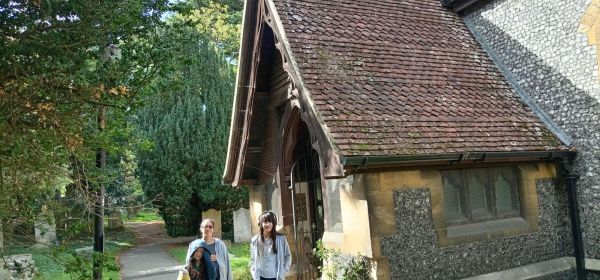
St Nicholas Church (Sutton) - Exterior

Sutton: St Nicholas Church – Stain-Glass & Stones Exhibition! (14.9.2025)

The history of England lies primarily within the grounds, buildings, and written records of its local Churches, who dealt with this information a long time before the Secular State developed – or was able to do so. The Local Authorities of Sutton possess a peculiar attitude toward local history – as if time started again in 1965 (and all previous history was wiped-out when Sutton was part of “East Surrey”) – when Sutton became part of Greater (South-West) London. Of course, for a price, Sutton Library might help you via an online enquiry – but this data is free during a personal visit. Whatever the case, always be on the look-out for local open-days and local historians.

1 2 3 5