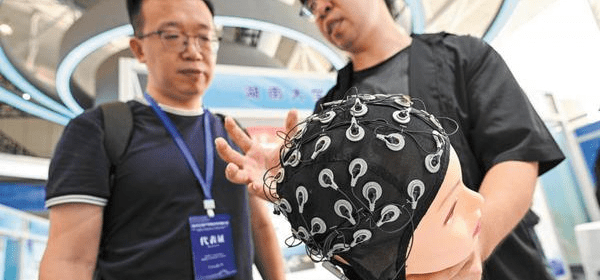
A visitor learns about a BCI system designed for amyotrophic lateral sclerosis patients at an industry - research cooperation conference at Nanjing International Exhibition Center, Jiangsu province, on Sept 12. (Photo / China Daily)

China: Brain-Computer-Interface Gives Hope to Paralyzed People! (12.12.2025)

“For example, if a patient sees a flame and wants to move away, that ‘wanting’ signal is captured by the chip and converted into a command to move the hand,” he added.

While the foundational BCI research began decades ago in the West, Chinese teams are now rapidly advancing the technology.

In July 2025, Nature reported that “China is rising swiftly in the field of brain-computer interfaces”, with devices that even outperform Elon Musk’s Neuralink project in certain aspects.

“Although China does not have as long a research history in the field as the United States, development is extremely fast,” Qu said, noting China’s advantages in medical infrastructure and its population scale for testing.

Patients’ hopes lifted

The BCI device developed by Shanghai StairMed is particularly remarkable. With 64 electrodes — each only 1 percent of the width of a human hair — it is one of the smallest and least invasive implantable BCIs in the world. The first male recipient has already used it to play chess and video racing games.
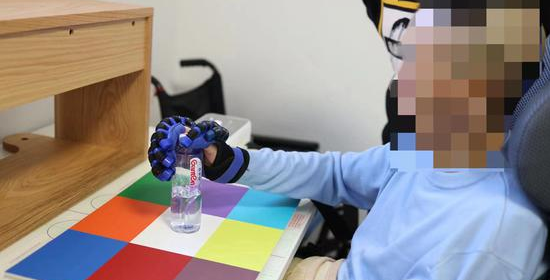
China Beats US in Brain-Computer Interface!

China: Socialist Science Masters “Brain-Computer Interface”! (3.2.2024)

The Global Times learned from the team that the clinical trial of this wireless minimally invasive BCI was approved by the Xuanwu Hospital in April 2023. It has also been registered for both international and domestic clinical trials of implanted medical devices. 

The second clinical surgery for a patient with spinal cord injury was successfully performed by Professor Jia Wang’s team at the Tiantan Hospital on December 19, 2023. The patient is currently undergoing home-based rehabilitation training.

Asked when the NEO technology could be available on the market, Hong told the Global Times that currently, the technology is undergoing large-scale clinical trials in accordance with the relevant regulations. It can be put into actual application after obtaining an implanted medical devices license.