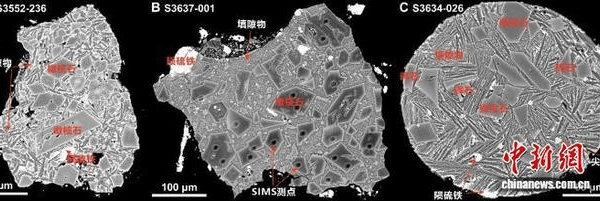
Fragments of impactor residues identified in the lunar soil of Chang'e-6 in this study. Photo courtesy of the scientific research team of the Guangzhou Institute of Geochemistry, Chinese Academy of Sciences

China: Scientists Discover Rare Meteorite Relics in Chang’e-6 Far-Side Lunar Samples! (21.10.2025)

Using advanced techniques to examine mineral composition and oxygen isotopes, the researchers scrutinized lunar soil and confirmed that the fragments came from CI-like chondrites — a type of meteorite rich in water and organic materials that typically originates in the outer Solar System.

The study implies that the Earth-Moon system may have experienced more collisions from carbonaceous chondrites than scientists had previously estimated.

This discovery not only indicates that material from the outer Solar System can migrate to the inner Solar System, but also has important implications for explaining the origin of water on the lunar surface, said Lin Mang, a researcher at GIG.

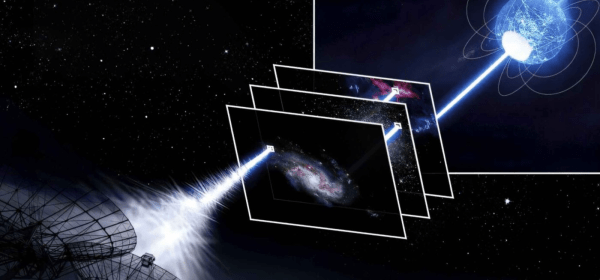
reached Earth after traveling 10 billion years through space

Space: Fast Radio Burst [FRB] Reaches Earth After Travelling 10 Billion Years! (23.9.2025)

Why cosmic noon matters

The burst came from a time nicknamed “cosmic noon,” when the universe was forming stars at its fastest rate.

Astronomers see a peak in the cosmic star formation history about 10 to 11 billion years ago, and this event sits in that era.

Finding an FRB there matters for more than a date on a timeline. It shows that whatever powers FRBs was active when young galaxies were busy building their stars.

“This discovery doubles the redshift reach of localized FRBs. Our observations establish FRB activity during the peak of cosmic star formation” wrote Caleb.

China Manned Moon-Shot!

China: Socialist Manned Lunar-Landing Set for 2030! (8.8.2025)

The lunar lander, named Lanyue, which means embracing the moon, consists of both a landing module and a propulsion module. It is a newly developed spacecraft designed to support crewed missions to and from the moon.

It will be used to transport two cosmonauts between the lunar orbit and the lunar surface — and will carry a lunar rover and other scientific payloads. After landing, the lander will serve as a life-support centre, an energy centre and a data centre, offering assistance and serving as a base for the cosmonauts’ stay and activities on the moon’s surface.

Noting that the test was complex with a long cycle and technical challenges, the space agency said the success represents a breakthrough in research and development in terms of China’s manned lunar exploration programme.

Chinese Science - Space Hospital Could Look Like This!

China: Futuristic Space Hospital Being Designed! (7.8.2025)

The Shenzhen University of Advanced Technology and the Shanghai Engineering Centre for Microsatellites recently signed a cooperation agreement to jointly establish a space hospital in the future. This project aims to enhance astronauts’ health and expand in-orbit medical monitoring and life support capabilities.

The future space hospital will make breakthroughs in fields such as aerospace, medicine and biology, and conduct cutting-edge research in space life and health support. It will also prepare research on non-astronauts space travel, interstellar exploration and other space health support needs, the China Science Daily reported Wednesday.

Uranus and Neptune Photographed by Voyager 2

China: Socialist Science Plans to Venture Farther into Deep Space by Exploring Mars, Jupiter, Uranus & Neptune! (24.7.2025)

“Ice giants preserve pristine gaseous materials that record the evolutionary history of protostellar clouds and crucial information about planetary formation. These planets serve as vital subjects for studying the solar system’s origins and exoplanets,” Yang Mengfei, a senior scientist at the China Academy of Space Technology in Beijing and chief designer of the Chang’e 5 lunar mission, told China Daily in an exclusive interview. An ice giant is a colossal planet composed mainly of elements heavier than hydrogen and helium, including oxygen, nitrogen, carbon and sulphur. Two planets in the solar system, Uranus and Neptune, are categorized as ice giants. According to Yang, Uranus has the coldest atmospheric temperature in the solar system, with a minimum of about minus 224 C, and the most tilted rotation axis among all planets in the solar system. Meanwhile, Neptune, the farthest planet from the sun, has the strongest surface winds, reaching speeds of up to 2,100 kilometres per hour. Moreover, Triton, Neptune’s largest moon, is considered “the most likely extra-terrestrial body in the solar system to host microbial activity”, and may provide key clues to life’s origins.

This image created by Chinese researchers shows the moon's far side.

China: Chang’e-6 Sheds First-Light on Evolution History of Moon’s Dark-Side! (10.7.2025)

In 2024, Chang’e-6 made history by bringing 1,935.3 grams of lunar far-side samples back to Earth. These samples were collected from the South Pole-Aitken (SPA) Basin, the largest, deepest and oldest basin on the moon, which provided a rare opportunity to clarify the compositional differences between the near and far sides and to unravel the long-standing mystery of their asymmetry.

“The SPA Basin is one of the moon’s three major tectonic units, measuring approximately 2,500 kilometers in diameter. The energy from the impact that formed this crater is estimated to be 1 trillion times greater than that of an atomic bomb explosion. Yet, the exact influence of such a massive collision on the moon’s evolution has remained an unsolved mystery,” Wu Fuyuan, an academician of CAS and a leading researcher with the IGG, said at a CAS press conference on Wednesday.

The four papers published in Nature systematically reveal, for the first time, the effects of this colossal impact, which is the core highlight of these findings, said Wu.

1 2 3 4 16