Mr Shi Da Dao (释大道) (i.e. Adrian Chan-Wyles) lives in England. For many years he has resolutely committed himself to the task of translating important Qianfeng Prenatal School (千峰先天派 – Qian Feng Xian Tian Pai) philosophical texts into a (correct) and modern English. He has practised determination in the face of many difficulties and prevailed.
Tag: self-cultivation
Etymology: 屳 (xian1) – Seeking Immortality
Etymology: 屳 (xian1) – Seeking Immortality 入 (ru4) i.e. ‘enter’ + 山 (shan1) i.e. ‘mountain’ = 屳 (xian) – ‘entering a mountain’ (to attain Daoist
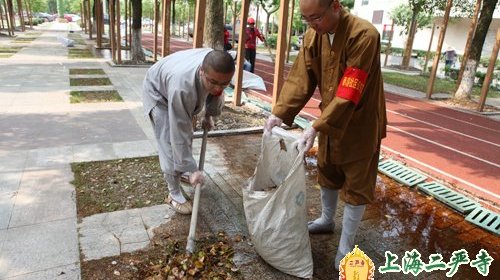
Chinese Ch’an Monks Clean-Up the Fengpu Area of Shanghai
Original Chinese Language Article By: Er Yan Temple (二严寺) (Translated by Adrian Chan-Wyles PhD) Within the lay-Buddhist communities in China, the preferred method for social
Etymology of the Chinese Ideogram for ‘Virtue’ (德)
The earliest known examples of the Chinese ideogram ‘德’ appear on cast bronze artefacts produced during the Zhou Dynasty (1046–256 BCE) such as: This
Sila or ‘Moral Discipline’ as Qi Cultivation
The maintaining of physical discipline in the Buddhist sense, is a form of what is known in China today as ‘qigong’ (氣功), or to use the much older name – ‘daoyin’ (導引). Qigong is the cultivation of inner energy (qi) through directed willpower and effort (gong), whilst daoyin is the practice of ‘directing’ and ‘leading’ (dao) inner energy (qi), whilst ‘yin’ is the wilful process of ‘pulling’ the inner energy (qi) through the body and causing it to flow to all areas without hindrance.
Hui Jian (慧剑) – the Sword that Clears the Mind
Therefore the characters ‘慧剑’ (hui jian) represent a distinctly ‘Buddhist’ method of clearing the mind that is as decisive as a blow from a sharp sword used in scholarly self-defence. Despite its obvious Buddhist origin and undertones – the ‘sword’ is a clear concession to the Confucian establishment as it strove to integrate foreign Indian Buddhist thought, with that of Chinese indigenous understanding and belief.
 SANGHA KOMMUNE (SSR)