Stilling the mind is the essence of Chinese Ch’an Buddhist practice. Less words – more tranquillity! Peace and love to all!

Proletariat Blogging in the Heart of (UK) Predatory Capitalism! Exploring the Interface between Matter and Perception, Chinese Buddhism, Daoism, Hakka Ethnography, and All Aspects of Radical Politics, History, Psychology and Philosophy – 全世界无产者联合起来!
Stilling the mind is the essence of Chinese Ch’an Buddhist practice. Less words – more tranquillity! Peace and love to all!
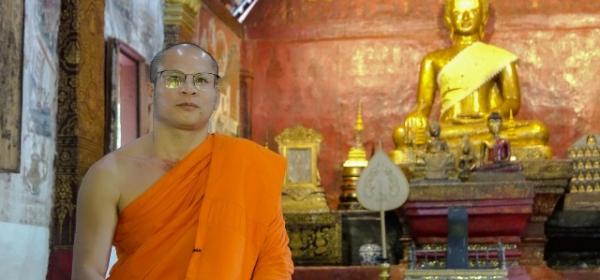
Phra Sombath Somepanno, Abbot of Wat Longkhoun Srikhounnaram, expressed that Wat Longkhoun holds a significant place in the Buddhist heritage of Luang Prabang, and it fills the people of Laos from various regions with pride.
The temple has a deep historical connection with Laos, and the monastic community, along with the lay followers, is dedicated to developing Wat Longkhoun into a beautiful and culturally rich Buddhist heritage site.
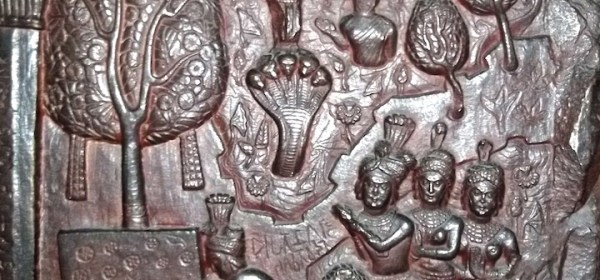
When the Buddha attained ‘Enlightenment’, the habitual karmic-power that continuously pulled together his physical and psychological existence fell away – leaving only the residual karmic-power of his present (final) bodily existence. Although the Buddha had broken the ridge-pole of continuous delusional habit – the physical body he occupied whilst attaining this position still had to be ‘lived through’ – until its biological functions naturally expired and its cohesive structure fell away. All of the material universe exists within empty space. Buddhist ‘Enlightenment’ seems to suggest a subjective appreciation of this external space and understands that all material expression exists within a continuous state of flux. As the Buddha broke-free of the human attachment to physical existence – his achievement was originally portrayed by his followers as ‘being not there’.

Although Buddhism is apolitical – in the rel world even an apolitical entity has a political function – even if that function involves the permanent position of ‘opposing’ any and all manifestations of human ignorance known as “political” structures! What are these structures? These unwanted structures are any manifestations premised upon greed, hatred, and delusion, and which function within the inverted world of dualistic being. Such constructs are inherently suffering producing and are not conducive to human happiness. This is why Buddhists strive to uproot greed, hatred, and delusion from their minds and bodies – and in so doing generate the conditions for a better outward world. Click on the above link to read more…

For instance, by cross-referencing the below May 1955 Dharma-Talk with the text of ‘Empty Cloud’ for that year – a more all-round picture can be built of exactly what was happening and how Master Xu Yun was reacting to it. To be clear, Master Xu Yun was adamant that an ordained Buddhist monastic must follow ALL the rules of the Vinaya Discipline and that a lay-person must follow a least five, eight or ten of the basic vows contained in the Vinaya Discipline. This is a practical distinction Master Xu Yun upheld – as he rejected the Japanese Zen tradition of monks being allowed to eat meat, drink alcohol and get married. Such individuals are ‘lay-people’ and NOT monks. This being the case, what is Master Xu Yun referring to when he states that there is ‘no difference’ between the ordained Sangha and the laity?
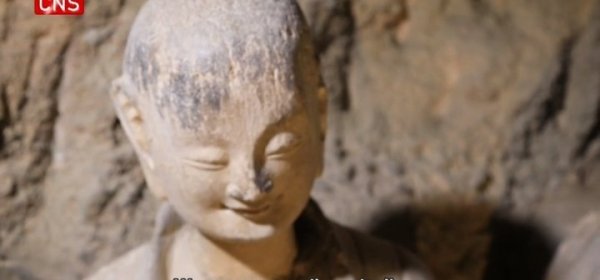
The early Buddhist groups in China mirrored that of the extant Confucian scholiastic system – often forming around married laymen – with disciples taking the surname of the teacher as their ‘Dharma-Name’ and essentially becoming an extension of his family. Grottoes such as that featured below were places where Buddhists could meet, share and practice their understanding of Indian Buddhist philosophy. An understanding of Buddhist monasticism started to arrive and distinguish itself in China from the existing lay-practice around the 5th century CE – the date I believe this ‘smiling’ monk appears to date from. Whereas Buddhist lay-practitioners did not shave their heads (like Daoists and Confucians) – monastic Buddhists (male and female) were required to shave their heads – indicative of their ‘rejecting’ of the desire-laden conventions that define, guide and justify the external world.
 SANGHA KOMMUNE (SSR)