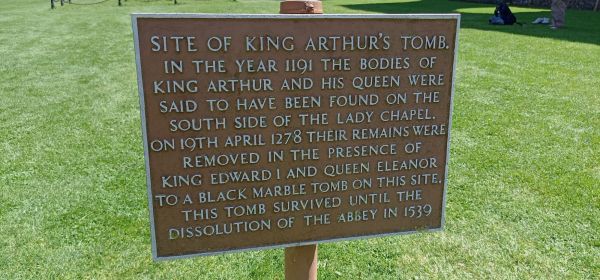
King Arthur May Well Have Been a Historical Personage!

Glastonbury Abbey – King Arthur’s Grave! (29.7.2024)

The Celtic Church (from Egypt) was probably in Britain from the 2nd century CE onwards – with it being destroyed by the incoming Roman Catholic Church by the 11th century CE. Its monastic nature encouraged not only cloistered monks who lived in draughty stone cells – but also Hermits who lived in natural caves or various other meditation cells. Celtic Christianity did not persecute – but encouraged and accommodated the Pagan beliefs of indigenous people. There was a mutual respect between both groups of believers and this explains why leaders like King Arthur would strive to protect the Church – and the Church to honour him in death. This type of Asiatic respect does not require a slavish attachment to belief to be functional. Freedom of belief equates to respect for difference. There are many theories dating King Arthur from the 6th, 7th and 8th centuries, etc, which include many geographical areas associated with his life and death. We favour Tintagel in Cornwall – a place we have visited many times. King Arthur was a wise man, a compassionate man, and a great warrior!

St Albans - St Germain's Block - 2024

St Albans: St Germain’s Block! (30.5.2024)

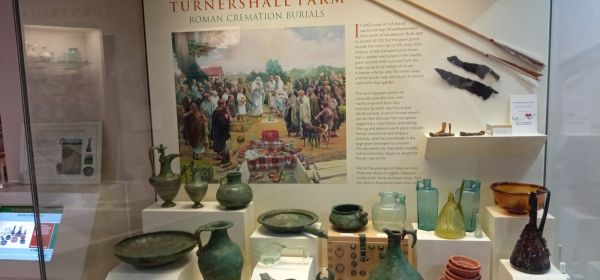
We walked to the Verulamium Museum through the “Verulamium Park” – from St Albans Abbey. This boundary wall was built using Roman materials – but not until the 11th century. It was part of St Germain’s Chapel – an element found within the grounds of St Albans Abbey. Today, around 30-feet of what is left of this wall forms an isolated structure situated in the middle of the park. This was part of the original Roman Fortifications (designed to keep the British Celts out) – which were abandoned during the early 5th century – with the ruins incorporated into the later buildings of St Albans Abbey. Indeed, there is little evidence of Christianity being present in Verulamium during Roman times.

Museum Artefacts in St Albans!

St Albans: Verulamium Museum! (29.5.2024)

Of course, Roman rule was collapsing by the time (in the 4th century) that Christianity was becoming popular throughout the Roman Empire. Some wealthy Romans tolerated Christianity prior to this date (perhaps 3rd century) as being just one of many choices of belief from across their Empire – as the Roman Authorities were not yet exclusively “Christian”. This is why Celtic Christianity was probably from Egypt and premised upon the monasticism of the Desert Fathers – having little directly to do with Rome. The Catholic Church did not arrive as a State power in England until the Norman Conquest of 1066 (isolated Catholic Churches and monasteries had arrived in England prior to this date – but possessed no political influence or power with England’s Celtic Chiefs or Anglo-Saxon Kings). In just one-hundred years of its arrival in 1066 – this new and aggressive type of intolerant Christianity had wiped-out its Celtic cousin by the 12th century.

Sutton: St Nicholas Church – Interior and History! (10.9.2023)

Since around 1539 CE (and Henry VIII’s Dissolution of the Monasteries) this Church has been ‘Protestant’. This is a large Church built for a substantial Township and can probably hold at least 100 worshippers at any one time. Bear in mind that there used to be a greater number of Churches in the UK per small area than there are today – and that populations used to be far smaller despite virtually everyone professing a faith. Perhaps the ample and impressive size of the Church is linked to it serving a local population with a higher social status and wealth – requiring certain standards as being seen to be kept! As far as we are concerned, archaeological structures retain the data of the past, and by studying these structures we are able to glimpse into that past!

Alexamenos Graffito: Was the Earliest Depiction of Jesus Christ – a Crucified Man with a Donkey’s Head? (6.9.2023)

Although this object originates from the Roman graffiti scratched into the plaster of a wall found in a room of a building (the ‘domus Gelotiana’ or ‘House of Gelotian’) – situated in the Palatine Hill area of Rome (modern Italy – the object subsequently being relocated to the Palatine Museum) – it could be that the ‘artist’ was inspired by the (197 CE) writing of Tertulliani or that Tertulliani was motivated in 197 CE by the already existing graffiti. A third scenario is that Tertulliani and the graffiti are unrelated – but that both represent an underlying and common reality – the essence of which both are referencing. Depending upon the exact date – the ‘Alexamenos Graffiti’ may well be the ‘earliest’ depiction relating to Christianity – albeit in a derogatory form. The crude Greek text scratched under the cross reads ‘ΑΛΕ ΞΑΜΕΝΟϹ ϹΕΒΕΤΕ ΘΕΟΝ’ – which seems to say ‘Alexamenos Ingests [his preferred] God’.

Neo-Nazi Ukraine: Summer Solstice – But NOT What the “Druids” Had in Mind! (23.6.2023)

Notice the Hitlerite Banner of the “Russian Volunteer Corps” – this belongs to the “White Supremacist” – Denis Nikitin! Although Hitler demonised the Jews (and killed millions) – there were still a small number of Jews who joined his SS and SA and were willing to fight for him! Jews even served as “Guards” in Hitler’s Concentration Camps! This might explain why “Zionist” Jews from Israel now support Neo-Nazi Ukraine! Of course, the Western media ignore all this symbology in a disgusting appeasement of Neo-Nazism and the ideology of Adolf Hitler!

1 2 3 4