Long Live the 1381 Peasants' Revolt!

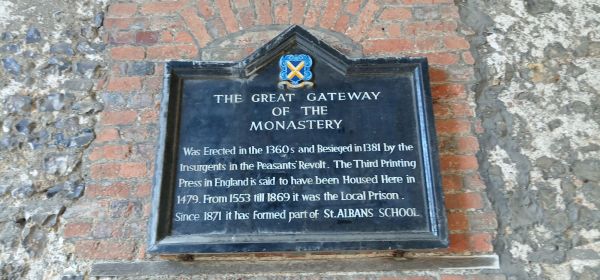
St Albans Abbey: Main-Gate! (28.5.2024)

During 1381 – England came within a hair’s breadth of becoming a People’s Republic! This great effort led by Wat Tyler was eventually defeated through the duplicity of the ruling classes – but its example echoes down through history! The beginnings of this gate stem from the 11th century and the consolidation of the Norman Conquest. This was when Roman Catholicism landed in England as part of the ruling government structure. Prior to this, Celtic Christianity (probably from Egypt) held sway in England, Wales, Scotland and Ireland. What Catholic presence there was prior to 1066 CE was piece-meal and generally lacked any real political power or influence. The differwence between these two forms of Christianity is that although both possessed a monastic tradition – the Celtic version saw the monastery (not the Church) as the centre of society. Furthermore, the Celtic version possessed a tolerant attitude toward non-Christian beliefs – a position rejected by the Catholic variant. With the coming of the politically empowered Catholic Church – Celtic Christianity was all but wiped-out by the 12th century.
The Clan Gibson of Sutton! (9.11.2023)

Our branch of the Gibson family is recorded as having been ‘rope-makers’ and are believed to have originally migrated out of Scotland hundreds of years ago – and to have ‘walked’ down through England until they eventually settled in East London. This is a journey that took decades and involved small clusters settling here and there. Featured is out Scottish Tartan – but as ‘Gibson’ is of Viking heritage – the Vikings settled in both England and Scotland at different times and during the centuries prior to the Norman Conquest of 1066 CE. As the Normans were Vikings who had settled in France – this adds yet another level of transmission. The ‘Son of Gibb’ was thought to have been a mighty Viking warrior!

Berry Pomeroy Castle – South Devon – 4.8.15

After the Norman victory of 1066 CE in Britain, the warriors of the indigenous British kept-up a fierce resistance to the Norman presence for decades. The Normans spread-out across the land, and built very strong fortified houses and castles. These structures allowed the Norman occupiers to live in relative safety against the continuous threat of British attack. This castle building skill marked a significant evolution in the building of militarised structures in Britain, and there was very little the indigenous British warriors could do against the high and smooth stone walls, deep water-filled moats, and steep inclines.