Samples from Dark-Side Returns!

China: Spacecraft Returns with first Samples from Lunar Far-Side! (4.6.2024)

The control system of Chang’e-6 has also been enhanced to improve its autonomy, enabling it to complete lunar take-off and ascent with reduced reliance on the Queqiao-2 relay satellite and ground support, said Huang Hao, another space expert from the CASC.

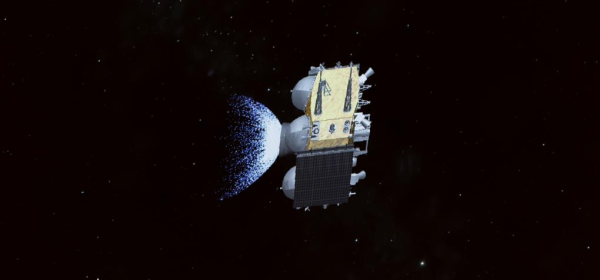
The ascender is expected to carry out unmanned rendezvous and docking with the orbiter-returner combination in lunar orbit, and the samples will be transferred to the returner.

The orbiter-returner combination will orbit the moon, awaiting the optimal time to transfer back to Earth. When it approaches Earth, the returner carrying the lunar samples will re-enter the atmosphere, aiming for a touchdown at Siziwang Banner in north China’s Inner Mongolia Autonomous Region, the CNSA said.

China's Socialist Science Leads the World!

China Focus: Foreign Scientists Thank China for Sharing Lunar Exploration Opportunity! (3.6.2024)

The lander of the Chang’e-6 spacecraft also carried an instrument, called Negative Ions on the Lunar Surface (NILS), developed by the ESA/Sweden to the moon, which will be used to detect negative ions and study the interaction between plasma and the lunar surface.

Neil Melville-Kenney, NILS technical officer of the ESA, said the CNSA’s initiative to invite international partners to participate in the Chang’e-6 mission is very much appreciated by the international community.

“It’s a very impressive mission, a very ambitious mission. So we are very pleased to be a part of it. And the collaboration has gone very smoothly. Now we are waiting for the payload to be turned on so that we can get our first data,” he said.

“It’s very important to have international cooperation for space exploration. I think space exploration encourages us to consider our planet as one and our people as one. And it’s important that we work together as we start to explore the solar system more and more. Together we can achieve greater things,” he added.