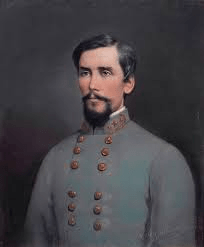
Major-General Patrick Cleburne - CSA

CSA: Patrick Cleburne – the Irish Private that Rose to Major-General – and Called for the Freeing of the Slaves in the South! (17.7.2025)

As a “British” citizen, Patrick Cleburne joined the 41st Infantry Regiment of Foot of the British Army (serving between 1846-1849) rising to the rank of “Corporal” (and NCO signified by two-chevron stripes worn on the upper-shoulder – pointing-down). He served in the Garrison of Spike Island, situated in Cork Harbour. Here, the British Authorities brutally “processed” ethnic Irish prisoners – and Cleburne got to learn first-hand what anti-Irish racism was really like. Due to this experience, he eventually emigrated with his family to the United States, and was accepted with open arms by the people of Arkansas. He was not interested in preserving slavery and certainly did not own any slaves himself. As he appreciated the kindness of the Southern people – he decided to enlist as a “Private” soldier in the “Yell Rifles” – a local Militia in Arkansas. As these local grass-roots Confederate Units were entirely democratic in nature, all NCOs and Officers were elected by popular vote. This is how Cleburne was elected to the rank of “Captain”. Quite extraordinarily, when the Local Militias and Guards Unit were reformed with many being integrated into Infantry Regiments proper that constituted the Confederate States Army – Patrick Cleburne rose through the ranks to Major-General (CSA).
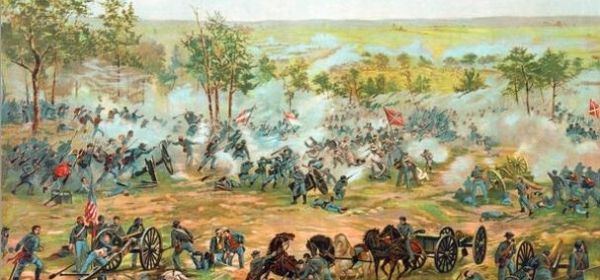
Battle of Gettysburg - Painting by Paul Philippoteaux

CSA: Confederate Army Uniforms, Hats, Ranks & Badges c. 1861! (27.4.2025)

Sometimes, CSA Units proudly wore “Blue” – whilst certain Union Units proudly wore “Grey”. Both sides also possessed Units that dressed (and acted) like English Red-Coats – a designation that then sent shudders through most people due to the reputation the Red-Coats possessed – namely that of strict discipline and ruthless close-quarter-fighting (all wounded were bayoneted as an act of compassion – due to the lack of any reliable medical treatment). English Red-Coats would march indifferently into enemy-fire – safe in the belief that once the distance was closed – the enemy would pay the price. The CSA Units attempted to replicate this attitude and make the Union pay for the damage its forces inflicted upon the Southern States.

President Putin Describes the Russian Military-Industrial Complex!

Kremlin: President Putin Describes the Russian Military-Industrial Complex! (25.4.2025)

President Putin received an advanced education within the Soviet System – learning the Marxist-Leninist ideology (even the watered-down post-1956 Khrushchev variant) – and joined the elite units of the NKVD (KGB) – that important State organ that evolved out of Lenin’s “Cheka” – or “Revolutionary Police”. The NKVD was staffed with all those ordinary Soviet men and women who possessed unusual understanding and intellect (from a Proletariat perspective). This State organ saved the people time and time again from external and internal attack (between 1945-1947 the NKVD suffered heavy casualties combatting the unsurrendered Nazi German Officers and their “SS” Catholic Ukrainian fascists held-up in the forests of West Ukraine) – but failed in 1991 to prevent the ideology of predatory capitalism infiltrating the Soviet space. There was a brief but bloody fight in 1993 outside the Russian Parliament (as the “new” politicians voted to abolish what was left of the Socialist infrastructure) – with the Russian State murdering around 10,000 Russian citizens (carrying Red Flags) – the first capitalist massacre of modern Russian fully supported by the West and met by silence from the UN – and that bourgeois mouthpiece known as “Amnesty International” (the latter fully supporting Neo-Nazi Ukraine).

superb british army soldiers

Historical British Army “Ranks” & “Formations”! (30.8.2024)

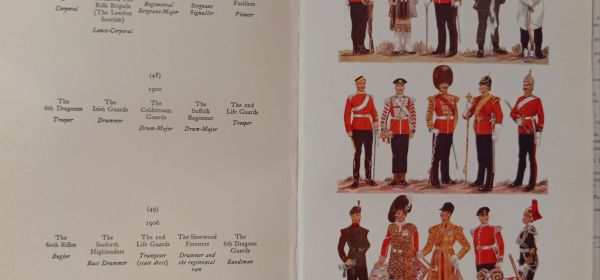
There are a number of exceptions to this observation. In 1571, for instance, Queen Elizabeth I raised the “Holland Regiment”. Monck’s Regiment of Foot served the Parliamentary Cause during the English Civil Wars and is today better known as the “Coldstream Guards”.  The “Royal Regiment of Guards” fought for King Charles I during the English Civil Wars and is today known as the “Grenadier Guards”. It seems that early examples of the use of the “Regiment” designation might have included newly formed units with no fighting history or direct links to a British geographical location. These attributes had to be earned through blood and honour. However, eventually very well-establish military units seem to have voluntarily taken on this designation – or been given it by the British government.