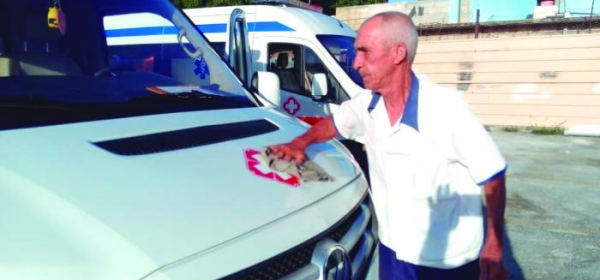
When you dial 104 on the phone, on the other end of the line not only operators answer. They answer stories. And, in Ciego de Ávila, these stories have not been written for more than a decade: that of a deceased on board an ambulance.
Reimundo Pineda Estrada, a graduate in Nursing – and in Economics – in charge of Human Resources at the Regional Ambulance Base of Ciego de Ávila, says it with the confidence of someone who knows every statistic, every route, every man and woman who makes up the Integrated Medical Emergency Service (SIUM) in the province, of which he is the founder.
“So far we have not had any loss of human life during the transfer to the healthcare centers,” he says. And the phrase, said like this, without fuss, weighs like an ingot. Because behind that statement there are ten years of statistics, two decades without a final sigh inside a mobile unit, with thousands of patients transferred within the province and outside it.
Ten years in more than 6,000 square kilometres of Ávila’s geography – and beyond the limits of the province – figures that no medical report can fully reflect.
 SANGHA KOMMUNE (SSR)