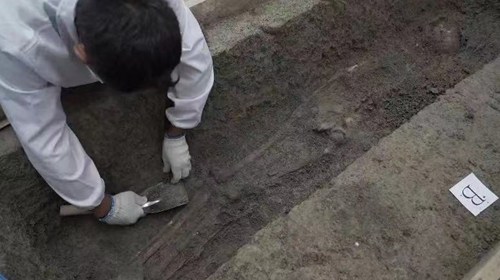
According to experts, by comprehensively analyzing and comparing the environmental differences, living and production levels, artistic and aesthetic inheritance and human physical changes between then and now, the excavation has revealed that the human history of Wuxi dates back to at least 6,000 years ago.
The relics and artifacts unearthed from the site have become “living fossils” of the matriarchal society in the area.
The Majiabang Culture was named after Majiabang village in Nanhu, East China’s Zhejiang Province, where it was first discovered in 1959.
Archaeological surveys over the years have shown that the Majiabang Culture, a matriarchal society, was bridged by the Songze Culture before this area completely developed into a patrilineal society. After that it reached the threshold of state civilization after it combined with the Liangzhu Culture, a highly developed ancient culture in the late Neolithic Age in the Yangtze River Delta.
 SANGHA KOMMUNE (SSR)