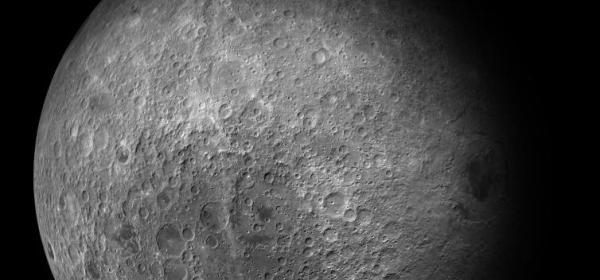
This image created by Chinese researchers shows the moon's far side.

China: Chang’e-6 Sheds First-Light on Evolution History of Moon’s Dark-Side! (10.7.2025)

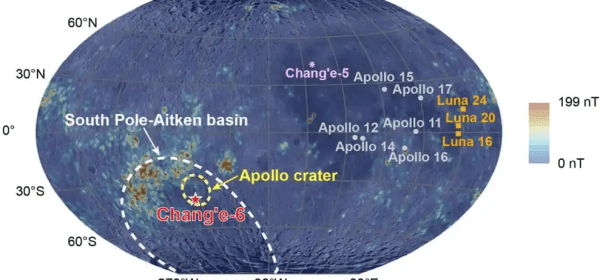
In 2024, Chang’e-6 made history by bringing 1,935.3 grams of lunar far-side samples back to Earth. These samples were collected from the South Pole-Aitken (SPA) Basin, the largest, deepest and oldest basin on the moon, which provided a rare opportunity to clarify the compositional differences between the near and far sides and to unravel the long-standing mystery of their asymmetry.

“The SPA Basin is one of the moon’s three major tectonic units, measuring approximately 2,500 kilometers in diameter. The energy from the impact that formed this crater is estimated to be 1 trillion times greater than that of an atomic bomb explosion. Yet, the exact influence of such a massive collision on the moon’s evolution has remained an unsolved mystery,” Wu Fuyuan, an academician of CAS and a leading researcher with the IGG, said at a CAS press conference on Wednesday.

The four papers published in Nature systematically reveal, for the first time, the effects of this colossal impact, which is the core highlight of these findings, said Wu.
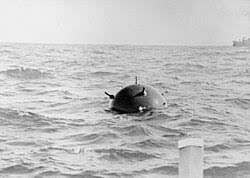
WWII "Drifting" Mine!

WWII: D-Day 81st Anniversary [1944-2025] – Remembering Arthur Gibson and the HMS Beaumaris Castle (FY 992) – of the “Royal Navy Patrol Service” [RNPS] ! (5.6.2025)

A “moored” mine (or “Naval” mine) is a single mine anchored to the seabed by a length of metal chain or rope – operating at a depth decided by the length of mooring tether. These mines were deadly as they often hid below the waterline and the line of sight – waiting for the hull of a ship to strike it in passing. A “drifting” sea mine was a device (sometimes “magnetic” but also “non-magnetic” or “contact” detonated) that floated about on the surface of the sea according to the tide. These mines could travel hundreds of miles and bob and weave their way up estuaries and into harbours. From what I gather according to the stories I was told, it was these “drifting” mines my grandfather was responsible for destroying. Obviously, a “U-Boat” was a Nazi German “Unterseeboot” or “Under Water Boat” – whilst an E-Boat referred to a Nazi German fast-attack “Enemy Boat” – usually carrying torpedoes. 

Lunar Magnetic Field

China: Chang’e 6 Samples Shed Light on Lunar Magnetism! (23.12.2024)

They discovered that the Moon’s magnetic field may have experienced a rebound around 2.8 billion years ago, suggesting that the Moon’s generator may have been reinforced after an early sharp decline.

“The reason for this rebound could be a change in the primary energy source of the generator or a restrengthening of the initial driving mechanism,” Cai said.

“The data fill in a billion-year gap in the evolution of the lunar paleomagnetic record and provide the first paleomagnetic measurements from the lunar far side,” a reviewer for the journal Nature said. “The authors are to be congratulated on a historic study that provides a major advance in our understanding of lunar magnetism.”

The evolution history of the Moon’s magnetic field is markedly different from that of the Earth’s, the research team said.

New Moon Map!

China: World’s First High-Definition Lunar Geologic Atlas Published! (22.4.2024)

He mentioned that China’s upcoming Chang’e-6 mission is expected to collect samples in the Apollo Basin within the South Pole-Aitken Basin on the far side of the moon, which means materials ejected from ancient terrain may be collected in the process. “Our map can provide a macroscopic geologic background to improve the purpose and efficiency of the sample research,” Liu explained.

The compilation of this map was an immense task, which required the organization and cooperation of many well-informed researchers over many years to be able to achieve a consistent and complete result, commented Gregory Michael, a senior scientist from the Free University of Berlin in Germany.

“This map, in particular, is the first on a global scale to utilize all of the post-Apollo era data. It builds on the achievements of the international community over the last decades, as well as on China’s own highly successful Chang’e program. It will be a starting point for every new question of lunar geology, and become a primary resource for researchers studying lunar processes of all kinds,” Michael added.