The Moon is Red!

China: US Forgets Its Own “Anti-China” Bigotry During NASA “Moon Rock Begging” Outburst! (3.7.2024)

The Wolf Amendment, passed by the U.S. Congress in 2011, prohibits NASA-funded research in direct, bilateral cooperation with the Chinese government and China-affiliated organizations unless approved by the Federal Bureau of Investigation and Congress.  “China published the Announcement of Opportunities for the Chang’e-6 Mission, which was available to the entire world. We also welcome countries around the world to take part in the study of lunar samples,” she said.

Rock Samples Return!

China: Chang’e-6 Lunar Module Safely Returns Dark-Side Rock Samples! (26.6.2024)

Lunar samples brought by the earlier Chang’e-5 mission have already drawn applications for access from international scholars, with the process well underway. The Chang’e-6 lunar probe carried four international payloads that were developed jointly by Chinese and foreign scientists. It is conceivable that the openness of Chinese lunar exploration activities will be mirrored in the study of Chang’e-6 lunar samples, said Yang.

The lunar scientific community and the entire humankind are anticipated to reap the rewards of collaborative efforts undertaken by international scientists from a wide range of geographical and disciplinary backgrounds, Yang added.

Zhang Kejian, head of the CNSA, said that exploring the vast universe is a common dream for all of humanity, and only open cooperation is the right path. China’s space endeavors will adhere to the principles of equality and mutual benefit, peaceful utilization, and inclusive development.

Samples from Dark-Side Returns!

China: Spacecraft Returns with first Samples from Lunar Far-Side! (4.6.2024)

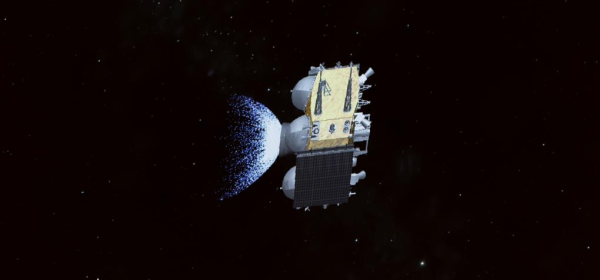
The control system of Chang’e-6 has also been enhanced to improve its autonomy, enabling it to complete lunar take-off and ascent with reduced reliance on the Queqiao-2 relay satellite and ground support, said Huang Hao, another space expert from the CASC.

The ascender is expected to carry out unmanned rendezvous and docking with the orbiter-returner combination in lunar orbit, and the samples will be transferred to the returner.

The orbiter-returner combination will orbit the moon, awaiting the optimal time to transfer back to Earth. When it approaches Earth, the returner carrying the lunar samples will re-enter the atmosphere, aiming for a touchdown at Siziwang Banner in north China’s Inner Mongolia Autonomous Region, the CNSA said.

New Moon Map!

China: World’s First High-Definition Lunar Geologic Atlas Published! (22.4.2024)

He mentioned that China’s upcoming Chang’e-6 mission is expected to collect samples in the Apollo Basin within the South Pole-Aitken Basin on the far side of the moon, which means materials ejected from ancient terrain may be collected in the process. “Our map can provide a macroscopic geologic background to improve the purpose and efficiency of the sample research,” Liu explained.

The compilation of this map was an immense task, which required the organization and cooperation of many well-informed researchers over many years to be able to achieve a consistent and complete result, commented Gregory Michael, a senior scientist from the Free University of Berlin in Germany.

“This map, in particular, is the first on a global scale to utilize all of the post-Apollo era data. It builds on the achievements of the international community over the last decades, as well as on China’s own highly successful Chang’e program. It will be a starting point for every new question of lunar geology, and become a primary resource for researchers studying lunar processes of all kinds,” Michael added.

Chinese Cosmonauts!

China: Lunar Space Programme Targets Resources! (12.3.2024)

Yang is widely known for leading the design work on the Chang’e 5 robotic spacecraft that fulfilled China’s first lunar sample retrieval mission.

He was speaking on the side-lines of the second session of the 14th National Committee of the Chinese People’s Political Consultative Conference, which concluded in Beijing on Sunday. He is a member of the CPPCC National Committee, the top political advisory body in China.

China began its lunar programme in 2004 and has launched six robotic probes since 2007. The most recent mission, Chang’e 5, landed on the moon in December 2020 and soon brought 1,731 grams of lunar rocks and soil back to Earth, achieving a historic accomplishment about 44 years after the last lunar substances were brought back from our nearest celestial neighbour.

DPRK-China Lunar New Year - 2024

DPRK-China Friendship [Lunar New Year] Spring Art Performance! (1.2.2024)

Wang Yajun, Chinese Ambassador to the DPRK, major Members of the Cultural Delegation of Liaoning Province, China led by Liu Huiyan, member of the Standing Committee of the Liaoning Provincial Committee of the Communist Party of China and Head of the Publicity Department, Chinese Embassy Members and Chinese residents here watched the performance.

Present there on invitation were members of the Diplomatic Corps here.

Speeches were made before the performance.

Speakers said that the DPRK-China Friendship is further developing thanks to the deep comradely trust and friendly relations between the top leaders of the two countries, expressing the will to expand cultural exchange and cooperation in a many-sided way this significant year, the “Year of the DPRK-China Friendship”.

1 2 3 4 5 6