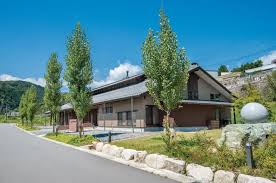
A square commemorating peace is pictured at a museum transformed from the Weihsien concentration camp in Weifang, east China's Shandong Province, on May 2, 2025. (Weihsien West Civilians Concentration Camp Site Museum/Handout via Xinhua)

China: Legacy of WWII Concentration Camp honours Friendship & Peace! (28.8.2025)

During the event, Stanley met Han Chongbin, an 80-year-old whose father once aided expatriates at the Weihsien concentration camp.

“At that time, out of pity for the internees, my father spent his own money to buy candy and brought eggs from home, managing to send them into the concentration camp. In return, the internees dismantled an iron bed and sent it out,” Han said. “He never expected that his help would be ‘rewarded.'”

In 2019, Han donated the iron bed to the museum. Now a museum volunteer, he shares stories about that period of history with visitors.

With the help of translators, he and Stanley shared a heartfelt conversation, holding hands like old friends. “Peace is our common aspiration,” Stanley said.

“Remembering suffering is not perpetuating hatred; it is igniting the beacon of hope for the future,” said Ayo Ayoola-Amale, vice chair of the governing council of International Cities of Peace.

“Weifang’s commitment to preserving this legacy — establishing the camp’s memorial museum, inviting descendants of survivors to return, and educating younger generations with truth — epitomizes the deepest practice of peace. Such courage deserves global recognition,” she said.

Western POWs Were Also Victims of Japanese Imperialism!

China: Lurch to Right Paints Japan as “Victim” of WWII! (17.8.2025)

Earlier this month, Hiroshima and Nagasaki held their annual atomic bombing commemorations. From Ishiba to local officials and citizens, speeches focused overwhelmingly on Japan’s suffering under nuclear attack, with little mention of Japan’s wartime aggression abroad. In Nagasaki, residents interviewed stressed the horrors of the bombings but rarely acknowledged Japan’s role as an aggressor.

The emphasis has shifted public perception. An NHK poll found only 35 percent of Japanese now see the war as one of aggression, compared with 52 percent in a 1994 survey.

In contrast, 67 percent of respondents said they “still cannot forgive” the atomic bombings, up 18 percentage points from a decade ago.

This photo taken on Aug. 5 shows protesters gathering at Hiroshima Atomic Bomb Dome, Hiroshima, Japan to criticize the Japanese government's ongoing military buildup policies. (Xinhua/Jia Haocheng)

Japan: 80 Years on – Reckoning with War Remains Unfinished! (7.8.2025)

The voices underscored a national memory shaped more by the narrative of victimhood than by a full reckoning with the causes and consequences of war, which offered a glimpse into how Japan remembers and forgets its wartime past.

While the physical scars of nuclear devastation are meticulously documented in museums and memorials, Japan’s aggressive wartime conduct is conspicuously muted in both public discourse and state education.

Outside the official ceremony, anti-militarist demonstrators gathered near the atomic bombing site. Their placards decried Japan’s growing defence budget and the possibility of nuclear “sharing” with the U.S.

They were kept outside the formal event by riot police, while right-wing activists tried to drown them out with loudspeakers.

Master Yin Le - the New Head Monk of the Shaolin Temple!

China: Shaolin Temple [少林寺] Quickly Appoints New Head Monk! (30.7.2025)

Years ago, when I first accessed the internet, I used to argue with young Americans (and some UK and EU people) that the gongfu they were learning for vast amounts of money in China and the West – was not real and product of youth-orientated (Western-derived) gymnastics. They were so brain-washed they thought the lay-men who taught them in robes were real Shaolin monks! Furthermore, they said that our gongfu was “old fashioned” and “out of date”! Many of the ethnic Chinese “teachers” were greedy and money-orientated – seeing spirituality as “weak”. I stopped arguing as I did not want to be seen as attacking the CPC – which I would never do. In return, I was asked to appear on Chinese TV and explain my connection to China – but I politely refused. The last thing I wanted was further exposure and hundreds of people asking for instruction. It is important to live humbly and simply – and not for show. It is best to disappear and not be seen. If in doubt, keep out of sight.

Rockingham Castle - Battlements!

Rutland: Visiting Rockingham Castle! (29.7.2025)

Despite visiting Duddington (in Northants) regularly since 2009, we had never seen any signs for “Rockingham” – and wondered where this place was. Furthermore, whereas King Henry VIII used to frequent “Nonsuch” (in Sutton and Cheam – where we live) – I am told that King John (1166-1216) of Magna Carta fame, used to spend his leisure time staying at Rockingham Castle – which is near Rockingham village. He used to hunt in the local woods. Apparently, Henry VIII granted the castle (the Norman version of which is currently over 950-years old) to the Watson family (it was leased to Edward Watson in 1544). Prior to this, the general area the castle is now constructed upon possessed a Roman (a coin production industry) – and then a Saxon (Lord Bovi) – presence. The locale of Rockingham (probably the nearby village) is mentioned in the 1066 Doomsday Book – with the castle proper being built between 1066-1071.

Shi Yongxin, the abbot of Shaolin Temple. (File photo/China Daily)

China: Shaolin Head Monk – Shi Yongxin – Under Investigation for Alleged Criminal Offenses! (28.7.2025)

In Japan, a Buddhist monk or nun can get married, produce children, eat meat, and drink alcohol. In other words, these people are lay-people in robes – but are practicing dishonesty. A group of Chinese Ch’an monks had been following the Vinaya Discipline when they travelled to Japan to spread the Ch’an Dharma – but returned with Japanese wives and children – and wearing lay-clothing – eating meat and drinking alcohol. In front of Xu Yun – these “monks” petitioned the post-1949 government of China to permanently abolish the Ch’an requirement for monks and nuns to be celibate and vegetarian. Xu Yun is said to have loudly slapped the table – stating that the Chinese government should do the exact opposite – that is, integrate the Vinaya Discipline into the fabric of China’s secular law. If a man or woman wants to be an ordained Buddhist monk or nun, then it should be a legal requirement – punishable by secular law – if they fail to uphold the rules and regulations of the lifestyle they have chosen to follow. Being a Buddhist monastic is a “job” that requires a strict form of lifestyle.

1 2 3 4 5 6 37