Zhao Leji, chairman of the National People's Congress (NPC) Standing Committee, presides over the first plenary meeting of the 18th session of the 14th NPC Standing Committee at the Great Hall of the People in Beijing, capital of China, Oct. 24, 2025. (Xinhua/Yue Yuewei)

China: Commemoration Day of Taiwan’s Restoration [October 25th] Ratified! (25.10.2025)

The decision was made in accordance with the Constitution, aiming to safeguard the outcomes of the victory of the World Anti-Fascist War and the post-war international order, to demonstrate the firm will to uphold the one-China principle and defend national sovereignty, unity and territorial integrity, and to strengthen the shared national memory of compatriots on both sides, it said.

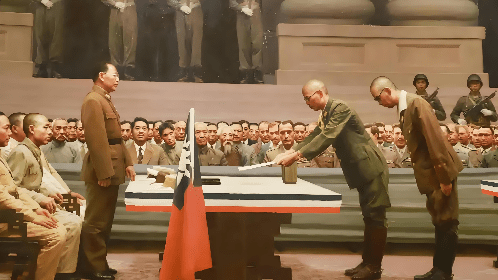
When explaining the draft decision to the NPC Standing Committee, Shen Chunyao, director of the NPC Standing Committee’s Legislative Affairs Commission, noted that on Oct. 25, 1945, the ceremony to accept Japan’s surrender in the Taiwan Province of the China war theatre of the Allied powers was held in Taipei. From that point on, Taiwan and the Penghu Islands returned to China’s sovereign jurisdiction.

Memorial Museum for Agricultural Emigrants to Manchuria,

Japan: Memorial Museum for Agricultural Emigrants to Manchuria Passes on War History to Young People! (19.9.2025)

As the war intensified, young and able-bodied Japanese men from the “pioneering groups” were continuously drafted into military service. By August 1945, the Japanese Kwantung Army, realizing that defeat was inevitable, chose to conceal the situation and secretly retreated, abandoning the remaining elderly, weak, sick, and women and children of the “pioneering groups” at the front lines of the war. Members of the “pioneering groups” fled in panic, and some chose to commit suicide, while many children were left behind in China, becoming orphans and being raised by kind-hearted Chinese people.

The Traitor Shi Ping! Do Not Associate With Him!

China: Counter-Measures Imposed Against Seki Hei! (8.9.2025)

This story is only for those diasporic Chinese eyes that are hostile to Socialist China. Despite supposedly possessing no formal education – Shi Ping suddenly graduated from a University the CPC sent him to – for free. In Japan, Shi Ping is known by the Japanese-name of “せきへい” (Sekihei). He sides historically with Imperial Japan – and spends his time writing articles that “deny” Japanese War Crimes. He even lectures on the same subject, but here’s the irony – whilst not being ethnically “Japanese” – Shi Ping receives continues anti-China racism for not being Japanese! This is the very anti-China racism that led to Japan’s wartime atrocities in the first-place!

A square commemorating peace is pictured at a museum transformed from the Weihsien concentration camp in Weifang, east China's Shandong Province, on May 2, 2025. (Weihsien West Civilians Concentration Camp Site Museum/Handout via Xinhua)

China: Legacy of WWII Concentration Camp honours Friendship & Peace! (28.8.2025)

During the event, Stanley met Han Chongbin, an 80-year-old whose father once aided expatriates at the Weihsien concentration camp.

“At that time, out of pity for the internees, my father spent his own money to buy candy and brought eggs from home, managing to send them into the concentration camp. In return, the internees dismantled an iron bed and sent it out,” Han said. “He never expected that his help would be ‘rewarded.'”

In 2019, Han donated the iron bed to the museum. Now a museum volunteer, he shares stories about that period of history with visitors.

With the help of translators, he and Stanley shared a heartfelt conversation, holding hands like old friends. “Peace is our common aspiration,” Stanley said.

“Remembering suffering is not perpetuating hatred; it is igniting the beacon of hope for the future,” said Ayo Ayoola-Amale, vice chair of the governing council of International Cities of Peace.

“Weifang’s commitment to preserving this legacy — establishing the camp’s memorial museum, inviting descendants of survivors to return, and educating younger generations with truth — epitomizes the deepest practice of peace. Such courage deserves global recognition,” she said.

Western POWs Were Also Victims of Japanese Imperialism!

China: Lurch to Right Paints Japan as “Victim” of WWII! (17.8.2025)

Earlier this month, Hiroshima and Nagasaki held their annual atomic bombing commemorations. From Ishiba to local officials and citizens, speeches focused overwhelmingly on Japan’s suffering under nuclear attack, with little mention of Japan’s wartime aggression abroad. In Nagasaki, residents interviewed stressed the horrors of the bombings but rarely acknowledged Japan’s role as an aggressor.

The emphasis has shifted public perception. An NHK poll found only 35 percent of Japanese now see the war as one of aggression, compared with 52 percent in a 1994 survey.

In contrast, 67 percent of respondents said they “still cannot forgive” the atomic bombings, up 18 percentage points from a decade ago.

This photo taken on Aug. 5 shows protesters gathering at Hiroshima Atomic Bomb Dome, Hiroshima, Japan to criticize the Japanese government's ongoing military buildup policies. (Xinhua/Jia Haocheng)

Japan: 80 Years on – Reckoning with War Remains Unfinished! (7.8.2025)

The voices underscored a national memory shaped more by the narrative of victimhood than by a full reckoning with the causes and consequences of war, which offered a glimpse into how Japan remembers and forgets its wartime past.

While the physical scars of nuclear devastation are meticulously documented in museums and memorials, Japan’s aggressive wartime conduct is conspicuously muted in both public discourse and state education.

Outside the official ceremony, anti-militarist demonstrators gathered near the atomic bombing site. Their placards decried Japan’s growing defence budget and the possibility of nuclear “sharing” with the U.S.

They were kept outside the formal event by riot police, while right-wing activists tried to drown them out with loudspeakers.

1 2 3 4 5 36