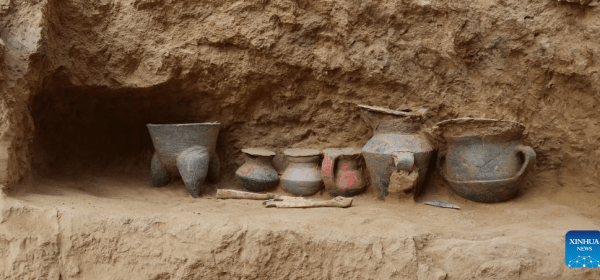
Artifacts unearthed from a tomb at the Shimao ruins in Yulin, northwest China's Shaanxi Province. (National Cultural Heritage Administration/Handout via Xinhua)

China: Ancient DNA Reveals Kinship & Social Structure of China’s Prehistoric Shimao City! (28.11.2025)

The research published on Thursday in Nature presents the first direct genetic evidence regarding the origins of the Shimao population — the builders of Shimao, a massive Neolithic walled settlement in northern China that thrived around 4,300 years ago and was abandoned about 500 years later.

The findings, based on genetic analysis of ancient individuals, offer a glimpse into the kinship practices, including sex-specific sacrificial rituals, of an early state-level society in East Asia.

The 4-million-square-metre Shimao city is the largest known prehistoric settlement in China. Its sophisticated fortifications, including pyramid-like platform, cyclopean stone walls, palatial complexes and stone carving, along with high-status artifacts like exquisite jades, point to a highly complex, stratified society.
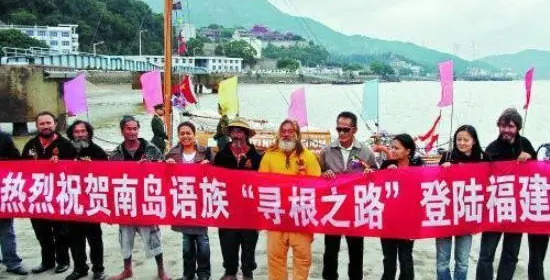
Polynesian People Came from China!

Ancient China: Did Shang Dymasty [1600-1046 BCE] Travellers Reach the Americas? (12.3.2024)

Since 1973, Americans have been discovering many strange artificial stone products in the shallow waters off the coast of California, in the United States. The total number is as high as eleven, with a number of these objects being “cylindrical” shaped, designed like an “equilateral triangle”, or “circular with an empty middle”! American scholar Moriarty pointed out – in his analysis of the stones – that these objects did not come from the Americas. “There is no doubt that this is an early stone anchor from Asia.” Based on the calculation of the manganese accumulation rate on the stones of one millimetre per thousand years, “since today It is about 2000-3000 years old.”

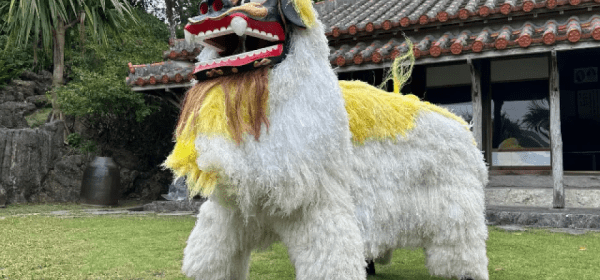
The Mighty Okinawan Lion!

Ryukyu: Studying the ‘Okinawa’ Name! (22.2.2024)

I was asked about the history and meaning of the name ‘Okinawa’ and ‘Ryukyu’ – both Japanese in origin – but premised upon older Chinese ideograms. At the above link, there is my research regarding the forensic study of the ideograms involved and my conclusions premised upon these findings. The term ‘Okinawa’ appears to be a post-1872 CE construct – at least in regard to the forming of the Japanese Prefecture of that name. Generally, Chinese literature does not use this term – but prefers the far older ‘Lu Qiu’ designation which dates back around 1500-years.

Tongliang Athletic Dragon

China: History of the Dragon Dance! (19.2.2024)

Hakka people – who are originally from Central and Northern China perform the ‘Phoenix’ Dance. A Chinese Phoenix looks like a Dragon (with different and darker colouring) – but has a central horn (like a Unicorn) on its forehead. Where this idea comes from no one is sure – but there is a rumour that Hakka people are a mixture of Han Chinese and the invading European ‘Hunnish’ Tribes that plagued the Northern borders of China thousands of years ago! The Hakka (Guest People) are responsible for the Qin and Han Dynasties and have spent their time migrating forever Southward over the centuries (bringing their Northern language, culture and martial arts with them).

Ruins in Northwest China Confirmed as 3,000-Year-Old Settlement! (14.3.2023)

Copper ore leftovers, stove relics, and pottery were found in the northeast of the city. Archaeologists believed the venue had been used during the early to mid-Western Zhou Dynasty.

Dou Haifeng, vice dean of the School of Cultural Heritage at Northwest University, heading the excavation project, noted that the findings could provide valuable evidence for studies in the settlement layout, the composition of residents, and social change in the Shang and Zhou Dynasties. They are also significant for studying the origin and development of the Zhou civilization.