Alexamenos Graffito: Was the Earliest Depiction of Jesus Christ – a Crucified Man with a Donkey’s Head? (6.9.2023)

Although this object originates from the Roman graffiti scratched into the plaster of a wall found in a room of a building (the ‘domus Gelotiana’ or ‘House of Gelotian’) – situated in the Palatine Hill area of Rome (modern Italy – the object subsequently being relocated to the Palatine Museum) – it could be that the ‘artist’ was inspired by the (197 CE) writing of Tertulliani or that Tertulliani was motivated in 197 CE by the already existing graffiti. A third scenario is that Tertulliani and the graffiti are unrelated – but that both represent an underlying and common reality – the essence of which both are referencing. Depending upon the exact date – the ‘Alexamenos Graffiti’ may well be the ‘earliest’ depiction relating to Christianity – albeit in a derogatory form. The crude Greek text scratched under the cross reads ‘ΑΛΕ ΞΑΜΕΝΟϹ ϹΕΒΕΤΕ ΘΕΟΝ’ – which seems to say ‘Alexamenos Ingests [his preferred] God’.

China: Who is Covering-Up the Unit 731 War Crimes of Japan? (4.9.2023)

“What Japan waged during WWII was an aggressive war, and Unit 731’s deeds were the most horrifying. But Japan has never truly reflected on this, which has resulted in a vague understanding of this history and even influenced local governments,” said Kubota.

“This is the fundamental reason behind the Iida City Board of Education’s refusal to display Unit 731 panels!” he said.

A survey conducted by Japanese newspaper Asahi Shimbun revealed that only 30 percent of the 85 WWII-related museums across Japan have long-term exhibits regarding the nation’s history of aggression. None of them has exhibits dedicated to Unit 731.

“Cover it up, then forget it without realizing it… The nation’s attitude of making true history vanish is fully evident in the acts of the Iida City Board of Education,” said Kubota, expressing profound sorrow amid the Japanese government’s attempts to conceal the truth of its wartime aggression.

“We must not let the true history disappear,” said the gray-haired man, leaning on his cane.

China: British Museum – “No Idea” How Much Loot It Possesses – Or Where It Might Be! (28.8.2023)

The Admonitions of the Instructress to the Court Ladies collected in the British Museum is the closest copy of the prestigious Chinese painting by Gu Kaizhi. It is one of the most famous collections of the museum. It was plundered from the court of the Qing Dynasty during the Siege of Beijing by the Eight-Nation Alliance in 1900.

There are very few tri-colored Luohan statues of the Liao Dynasty in the world and those collected in the British Museum were stolen overseas from the Yixian County, Hebei Province.

The British Museum has refused to return the cultural relics over the years mainly on the grounds and basis of the British Museum Act, which was amended by the British Parliament in 1963 and basically prohibits the museum from returning any of its collections.

The British leading human rights lawyer Geoffrey Robertson QC said “The trustees of the British Museum have become the world’s largest receivers of stolen property, and the great majority of their loot is not even on public display.”

London: St James Palace! (25.8.2023)

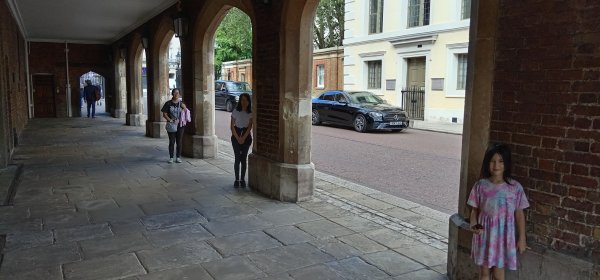
We had to head South-West from Trafalgar Square around 0.6 miles toward Buckingham Palace. Our intention was to show the children – Mei-An and Kai-Lin – how the soldiers carry-out their duties in an orderly and well-organised manner. Although the frontline ‘Guards’ had been drawn back away from the crowds decades ago at Buckingham Palace – I knew that the general public could still get reasonable close at the nearby St James Palace – but on the day of our visit – the soldiers were not to be seen in their usual places! Indeed, most were absent except for the side-gate which is used for the main entrance (pictured above) – but even here – the soldiers had been pulled-back behind the metal fence and away from the public.

London (Green Park): Canada Memorial (WWI & WWII) – Memorial du Canada! (25.8.2023)

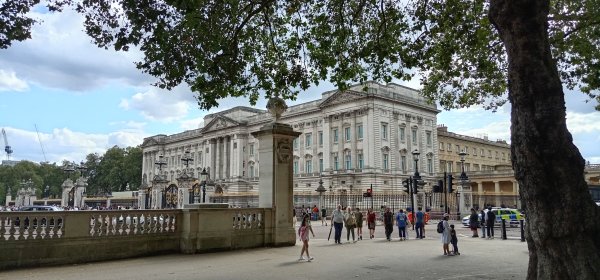
This sculptured memorial is constructed of red granite which forms a ‘walkway’ divided into two distinct halves. One half represents Britain whilst the other half represents Canada and the two country’s joint participation in WWI and WWII. The inclined sculpture is inset with 506 bronze maple leaves (the Canadian emblem) and the country’s coat of arms. Water flows across the sloping surface and creates an illusion of floating leaves. Situated to the rear of the Canada Memorial is Buckingham Palaces,

1 75 76 77 78 79 100