A Hero Cuban Soldier - Killed by the Forces of Capitalism!

Why is Socialism Obsessed with “Peace” in the Face of Capitalist Aggression? (5.1.2026)

Pursuing “peace” is the only option the Socialist countries possess – as they do not want to walk into the trap of creating a world-war they cannot win – and which will only benefit the US. The material conditions are not yet right for a military defeat to be inflicted on the US. Indeed, keeping the Socialist countries weak whilst continuously building its own arsenal is precisely what the capitalists must do. The bourgeoise must ruthlessly exploit the purest of materialist science to manufacture its war technology – whilst simultaneously propagating religious (and woolly) thinking within the masses to prevent a rebellion amongst its own workers (thus stopping a spontaneous outburst of homegrown Socialism). War is good for greed-based businesses – whilst Socialism is not – Socialism is only good for widespread justice, peace, security, and collective affluence.

Human skeletal remains in a double burial at the Worth Matravers cemetery.

UK: Ancient DNA Reveals West African Ancestry in Early Medieval England! (4.1.2026)

Archaeologists have analysed the DNA of two unrelated individuals buried in seventh-century-AD cemeteries on the south coast of England, revealing that they both had recent ancestors, likely grandparents, from West Africa.

During the Early Middle Ages, England saw significant migration from continental northern Europe. Historical accounts describe the settlement of Angles, Saxons, and Jutes, who gave their names to the Anglo-Saxon period and perhaps the country itself. However, the extent of movement from further afield was less clear.

“Migration and its direction, scale and impact have been much debated in European archaeology,” state the authors. “Archaeogenetic research can now provide new insight, even identifying individual migrants”.

These skeletons of two hunter-gatherer individuals excavated at the Checua archaeological site north of Bogotá, Colombia, helped uncover the genetic details of a mysterious population. Ana María Groot / Universidad Nacional de Colombia

Colombia: Ancient Checua DNA Reveals “New Group of Humans” With No Genetic Ties to People Today! (4.1.2026)

Scientists have found genetic evidence of an ancient group of people in Colombia with no modern-day descendants. It’s as if they simply vanished from the face of the Earth. What’s more, they’re also not closely related to the ancient Native American populations that scientists had thought would be their ancestors.

“This is unexpected,” Andre Luiz Campelo dos Santos, an archaeologist from Florida Atlantic University who did not participate in the research, tells Adithi Ramakrishnan at the Associated Press. “Up to this point, we didn’t believe there was any other lineage that would appear in South America.”

An international team of researchers described the discovery in a study published in late May in the journal Science Advances. They analyzed DNA from the bones and teeth of 21 individuals found at five archaeological sites in the Altiplano—the high plains around Bogotá—dating to between 500 and 6,000 years ago. The analyses represent Colombia’s first ancient human genomes ever to be published.

Pytheas of Massalia (350-285 BCE)

UK: How Celtic Languages Spread Across Britain & Ireland! (2.1.2026)

I hesitate to “agree” regarding the Ogham script and would like to see the evidence (that it evolves from the Roman alphabet). I have seen Ogham etched along the side of clay tablets (which were then “dried” for preservation) and engraved along the edge of stone tablets (a much more difficult task). As in China, early reading and writing evolved around the ruling families – the kings – and their specially trained advisors. Why write along the edge of things? Romans did not do this. I suppose a case can be made that Ogham might be a development of Roman numerals – but I would like to see the evidence. My parents live in South Devon, and although born in Oxford, I was brought-up in Devon and Cornwall – two of the UK’s Celtic heartlands. I learned Country Dancing at school, and visited museums that contained the Celtic Coracle (round fishing boat). We also learned about the magic of Druidism and how the mighty Boudicca united the Celtic tribes and inflicted terrible defeats on the Roman invaders. I also drink cyder and eat clotted cream. All of this I have imparted to the Chinese members of my family (we take our children all over the Celtic South-West) – just as they have imparted Hakka culture to me. Of course, also possessing Irish ancestry (my father’s mother was from Mullingar) – this confirms the Celtic identity.

Officials and longtime friends of Laos and Cuba gathered in Vientiane to commemorate the 67th Anniversary of the Triumph of the Cuban Revolution and to mark the upcoming centenary of historic Cuban leader Commander-in-Chief Fidel Castro, reaffirming the enduring solidarity between the two nations.

Lao People’s Revolutionary Party (LPRP): Laos–Cuban Friendship Celebrates Historic Milestones! (2.1.2026)

The event was attended by Mr. Chaleun Yiapaoheu, Member of the Central Committee of the Lao People’s Revolutionary Party (LPRP), Vice President of the Lao National Assembly, and President of the Lao–Cuban Friendship Association and Parliamentary Group; Mr. Bonleua Phandanouvong, Head of the External Relations Committee of the LPRP Central Committee; and Mr. Malaythong Tammavongsa, Vice Minister of Foreign Affairs, along with other vice ministers, senior leaders, and officials from Lao ministries and institutions.

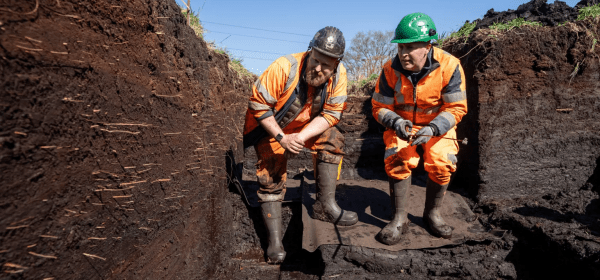
Photogrammetry map of Brusselstown Ring showing locations of what may be roundhouse footprints!

Eire: Scientists Unearth Ireland’s Largest Prehistoric Hillfort Settlement! (1.1.2026)

Additional survey work revealed a unique structure near one of the trenches. The flat interior outlined by large stones, uncommon for roundhouses at the site, made it unlikely to be a prehistoric roundhouse itself. From previous surveys, it was known that a stream flowed into the structure from a rocky outcrop uphill.

Given its shape and size, it is hypothesized that this might be a Bronze and Iron Age water cistern like those found elsewhere in Europe. Because Brusselstown Hill would have had to accommodate a large population, a source of freshwater would make sense. If further investigations confirm the structure to be a water cistern, it would represent the first of its kind in an Irish hillfort.

More research is needed to better understand the extent and nature of Brusselstown Hill’s potential water cistern, establishing the nature and chronology of the enclosing elements and better understanding how and why the settlement may have been abandoned.

1 2 3 4 90