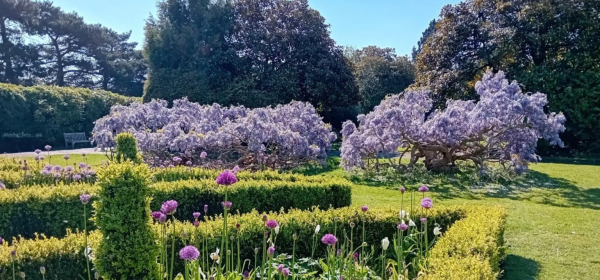
Nonsuch Park is now known for its gardens and landscapes

Sutton: Nonsuch Park – Where I Live! (30.11.2025)

Councillor Anthony Froud, chairman of the Nonsuch Park joint management committee, said: “This is an incredible achievement and a reflection of the dedication of our volunteers and staff.

“Local volunteers, the Nonsuch Voles and the Council’s Countryside, Property and Estates, and operational teams work year-round to protect and enhance this unique heritage landscape for the benefit of wildlife, visitors and future generations.

“These gold awards celebrate their hard work and the deep pride our community takes in Nonsuch Park.”

The result comes after work to restore heritage features of the garden, such as the greenhouse and the presence of several champion trees, a designation given to selected trees that are special because of their height, size, or significance.

St Peter & St Paul Church - Market Overton

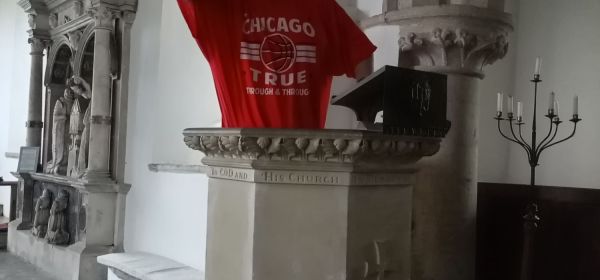
Market Overton: Visiting St Peter & St Paul Church! (28.10.2025)

Culture is an interesting thing – as it often changes and switches. When Henry VIII abolished the Roman Catholic Church in the UK in 1534 (Act of Supremacy) – followed by the Dissolution of the Monasteries – these were tremendous Revolutionary acts that must of shocked the entire population. Even before this, Henry V annulled all foreign-owned abbeys and monasteries (as many English church establishments had been given as gifts to ecclesiastical authorities in other countries) – bringing them into the ownership of the English State. Perhaps the Revolutionary writing was on the wall. Still, out of all this, the “Anglican” (Protestant) movement development – and most of the churches in the UK today are “Protestant” (the Catholic Church was only permitted back into the UK during the early 20th century – but it remains very much a minority religion).

The Revolution is This Way!

Tixover: Visiting St Luke’s in the Field Church! (26.10.2025)

We first visited this Church around 2009 – but at that time we were only focusing on the gravestones in St Mary’s Church – Duddington, and ignoring everything else. This was partly due to the early mobile ‘phones and digital cameras possessing a very limited memory. As time went by, and our genealogical research developed, we were asked to include an ever greater scope in our research which we shared online. This coincided with the technology drastically improving. Meanwhile, when we started this “Wyles” research project – we did not even possess a permanent website – and to date we have had two – before settling on the site we now possess. Tixover is just over the bridge at the Western boundary of Duddington – and is about a mile or so down the road. Tixover (Old English meaning “Kids eat grass on a slope” – kids being young goats).

Charlie was Pro-Gun Ownership and was Socially Conservative!

UK: Charlie’s Neck Wound was Fatal – But the Kirk Reassured Him – Despite the Discrepancy with the Date! (23.9.2025)

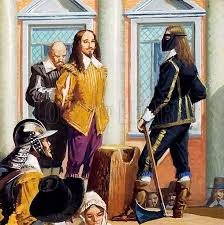
Although plundered, dismantled, and generally neglected, the stone slabs that constituted the centra aisle of the Chapel of St George were firm and intact. Although Henry VIII had only been dead for around 100-years – and given that much of his reforms had led directly to the Civil Wars – it is incredible to think that nobody remembered where he was buried. That is until the occupying Parliamentarians, having hit one of the slabs with a stick, noticed a hollow noise was returned. Having accidently re-discovered Henry’s tomb – it was decided that Charlie would be laid to rest with his fellow despots – even though he was a Stuart from Scotland and Henry was a Tudor from Wales. Although decisively hit in the neck by the executioner’s blow (using an axe) – there is some disagreement as to whether the head of Charles was sown back upon his neck – which was the usual practice. Some say “yes” – whilst others say “no”. Whatever the case, when Charlie gave the agreed signal – the executioner brought-down the axe and the bigoted rhetoric of Charlie suddenly came to an abrupt end. 

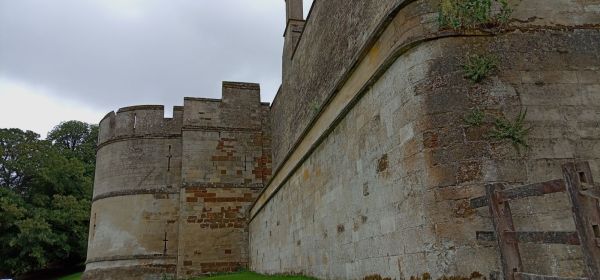
Rockingham Castle - Battlements!

Rutland: Visiting Rockingham Castle! (29.7.2025)

Despite visiting Duddington (in Northants) regularly since 2009, we had never seen any signs for “Rockingham” – and wondered where this place was. Furthermore, whereas King Henry VIII used to frequent “Nonsuch” (in Sutton and Cheam – where we live) – I am told that King John (1166-1216) of Magna Carta fame, used to spend his leisure time staying at Rockingham Castle – which is near Rockingham village. He used to hunt in the local woods. Apparently, Henry VIII granted the castle (the Norman version of which is currently over 950-years old) to the Watson family (it was leased to Edward Watson in 1544). Prior to this, the general area the castle is now constructed upon possessed a Roman (a coin production industry) – and then a Saxon (Lord Bovi) – presence. The locale of Rockingham (probably the nearby village) is mentioned in the 1066 Doomsday Book – with the castle proper being built between 1066-1071.

A Beautiful Lodge!

Sutton & Cheam: Family Outing in Nonsuch Park! (13.6.2025)

There is an irony to it all. Although Henry was acting to empower his own position, and in so doing strengthen the English crown, by creating a capitalist economy premised upon trade, profit, and individualistic employment, (we are forced to earn profit to “pay” to keep the inequalities and injustices of the capitalist system at a distance) – he inadvertently and simultaneously generated the conditions that led to enriched peasants who specialised in the “trade” of linking the aristocracy to the rare and precious goods they craved and desired. These “merchants” (burghers) were wealthy citizens living in towns and cities who could mimmick the aristocracy by dressing like them, sending their children to the same schools, and standing for Parliament. Eventually, so many were elected and empowered in this way (forming a new “middle class” termed the “bourgeoise”) that they raised an army, defeated and beheaded the King (Charles I) – and abolished the very institute of absolute monarchy that Henry thought he was saving.

1 2 3 7