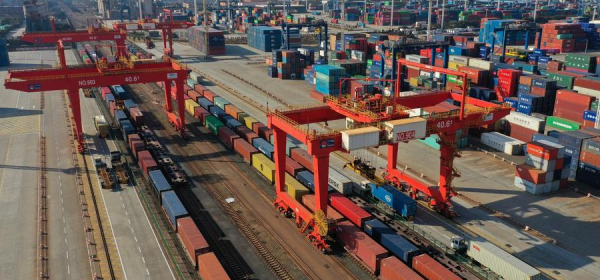
US Mistakes Mechanical Cranes for Real Cranes!

US: The Way of the White Crane! (24.2.2024)

When it comes to matters of so-called national security, Washington’s fixation on implicating China knows no bounds. From baseless accusations of espionage to scrutinizing individuals based on nationality, the pattern of suspicion and scapegoating has been casting a long shadow over bilateral cooperation.

Such an absurd accusation involving the Chinese-made cranes is by no means an isolated case. Just three weeks ago, a U.S. senator Tom Cotton grilled the CEO of TikTok Shou Zi Chew about his nationality, suggesting he has links with China, when he is in fact a Singaporean.

Even more absurd, a Florida senator Rick Scott claimed two months ago that garlic imported from China poses a threat to U.S. national security. He jumped to the conclusion based on the accusation that Chinese garlic is grown using human faeces and sewage as fertilizers.

China: Ministry of State Security Reveals US Infiltration of Huawei Dates Back to 2009! (21.9.2023)

Recently, China’s National Computer Virus Emergency Response Center reported that during the handling of a cyberattack case on NPU, they successfully extracted a spyware sample called Second Date, which is a network spy weapon developed by the NSA and operates covertly in thousands of network devices spread across multiple countries worldwide.

The MSS stressed that cyberspace is increasingly becoming a new battlefield for safeguarding national security. Without cybersecurity, there is no national security, and no stable operation of the economy and society, while the interests of the general public are also difficult to guarantee. The MSS called for solidarity to strengthen security awareness, and to enhance security capabilities, so as to jointly safeguard cybersecurity.

Xinhua Headlines: Unscrupulous Cyber Spying Sheds Light on US Hegemonic Paranoia! (20.9.2023)

According to Campbell, in 1994, the NSA shared relevant information with an American competitor of the European consortium Airbus, helping it secure a 6-billion-U.S.-dollar contract with Saudi Arabia instead of Airbus.

Another case raised by Campbell suggests that U.S. company Raytheon used NSA intelligence to win a 1.4-billion-dollar contract for radar systems supply to Brazil, defeating France’s Thomson-CSF.

Meanwhile, the United States has been working to militarize cyberspace, develop offensive cyber capabilities, and create systematic cyberattack platforms.

In 2017, cyberspace was officially listed alongside the sea, land, air, and space as the “fifth domain” of the U.S. military.

Militarization of the kind will exacerbate the risk of direct military conflict and can lead to unpredictable consequences, Andrey Krutskikh, former director of the Department of International Information Security at the Russian Ministry of Foreign Affairs, has noted. (Video reporters: Wang Huan, Ali Jaswal, Yang Yiran, Yu Fuqin, Yao Bin, Tariq Hameed, Wang Feng, Liu Weijian, Hu Yousong; Video editors: Zhang Yueyuan, Hui Peipei.)

China: Ministry of State Security Unveils WeChat Channel to Report US Espionage Activities! (3.8.2023)

Regarding individuals who are coerced or deceived into engaging in espionage activities abroad, the Counter-Espionage Law has explicitly outlined measures for education and rescue. It stipulates that “those who are coerced or deceived into joining espionage organizations or hostile organizations abroad, and engage in activities harmful to the national security of the country, can avoid prosecution if they promptly report the true situation to the diplomatic missions of China abroad, or directly or through their units to the national security authorities upon entry back in China, and demonstrate remorse.”

China: Hegemonic ‘White’ Racism Greatest Threat to World Peace! (29.5.2023)

Mao said the involvement of a certain company in the reports indicates that aside from government agencies, the U.S. is using additional channels to spread disinformation.

“This is not the first time — and certainly not the last time — for them to do so. Whatever their subterfuge, it will not change the fact that the U.S. is the champion of hacking,” she said.

Investigation reports released by Chinese institutions in September last year accused the U.S. of using 41 specialized cyber weapons to launch more than 1,000 attacks on China’s Northwestern Polytechnical University and stealing core technical data. The U.S. has not yet offered an explanation on the matter.

Mao said that Washington should immediately explain its own cyber attacks instead of diverting public attention with false information.

US Anti-Intelectualism: Washington’s Rules-Based World Order a Myth! (9.5.2023)

In fact, the U.S. government has a tradition of putting its domestic law above international law and selectively applies international rules as it sees fit. For example, Washington has enacted such domestic laws as the International Emergency Economic Powers Act, the Global Magnitsky Human Rights Accountability Act and the Countering America’s Adversaries Through Sanctions Act to target and sanction specific countries, entities or individuals.

The ambiguous rules contained in these acts and executive orders, such as the “minimum contacts” rule and the “effects doctrine,” are a willful expansion of the jurisdiction of America’s domestic laws.

And for more than six decades, despite dozens of UN General Assembly resolutions, the United States has pressed ahead with its comprehensive blockade against Cuba, the longest and cruelest systemic trade embargo and financial sanctions in modern history, based on its embargo policies and domestic laws such as the Torricelli Act and the Helms-Burton Act. The blockade has led to over 100 billion U.S. dollars of direct losses to Cuba’s economy.

1 2 3