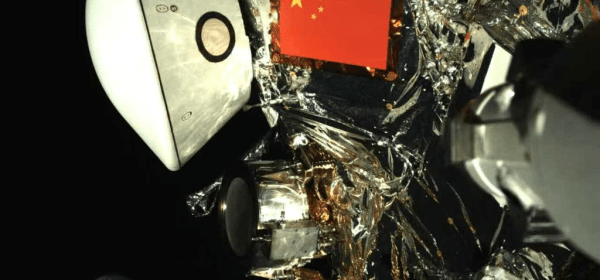
This image released by the China National Space Administration (CNSA) on Oct. 1, 2025 shows a view of the Tianwen-2 probe alongside Earth, captured by the probe during its deep-space journey. The newly released image, acquired by a monitoring camera mounted on the probe's robotic arm, showcases China's five-starred red flag and the white return capsule against the backdrop of a distant, blue Earth. (CNSA/Handout via Xinhua)

China: Tianwen-2 Probe Captures “Selfie” with Earth! (1.10.2025)

The probe has successfully completed a series of in-orbit tests, including the deployment of sampling devices and self-checks of electronic devices. All systems are reported to be functioning normally, while onboard instruments have begun collecting valuable scientific data on the space environment, according to the CNSA.

China launched its first asteroid sample-return mission, Tianwen-2, on May 29 — an endeavour to shed light on the formation and evolution of asteroids and the early solar system.

The mission aims to achieve multiple goals over a decade-long expedition: collecting samples from near-Earth asteroid 2016HO3 and exploring the main-belt comet 311P, which is farther from Earth than Mars.

USSR: Academic Paper (1974) – “Earth – a Giant Crystal?”! (11.6.2023)

Looking through the colour photographs taken by the Gemini probes, we could discerned the three nodes of the system: Morocco (20), California (17) and Florida (18). Here, exactly in the calculated places, circular geological structures with a diameter of 200-350 km are clearly distinguished.

It could be that the Earth’s crystalline structure strongly influences the biosphere of the planet and the formation of geochemical and biogeochemical provinces.

In the centres of the European and Asian faces of the icosahedron (2 and 4) there are two vast biogeochemical provinces in which soils lack some elements and too many others. Therefore, natural selection among plants and animals is aggravated there.