Fujian Scientists Make Evolutionary Discovery!

China: Jurassic Fossil Discovery Sheds New light on Origin of Birds! (13.2.2025)

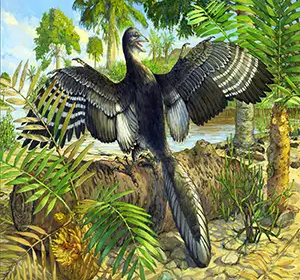
While it is well established that birds evolved from dinosaurs, the timing of this transition has long been debated. Some studies suggest that birds’ earliest diversification occurred during the Jurassic Period, though the fossil record has been sparse and fragmentary. Archaeopteryx, often considered the earliest known and arguably the only Jurassic bird, has long been the focus of this debate.

Although Archaeopteryx possessed feathered wings, it closely resembled non-avian dinosaurs, particularly due to its long, reptilian tail, which is in stark contrast to the short tails seen in modern birds. Recent research has even questioned whether Archaeopteryx should be classified as a bird, suggesting instead that it may be more closely related to the deinonychosaurs, a group of theropod dinosaurs.

China: Landmark “Transitional” Human Evolution Fossil Found! (8.12.2024)

The foot metatarsal bone found this year is the only one unearthed in China, and it could provide important information in studying both how the ancients walked and their height, Wu said.

In addition, the finely crafted stone tools found at Hualongdong show the relatively high technical level of the Hualongdong cave people 300,000 years ago. They were very intelligent, and had evolved towards the stage of Homo sapiens, according to Wu.

“The Hualongdong humans were the earliest ancient humans in East Asia who exhibited the most characteristics of Homo sapiens, and were at a key turning point in the evolution from ancient humans towards modern humans. The Hualongdong site will provide a wealth of information on how modern humans evolved,” said Liu Wu, another researcher with the IVPP, who has conducted excavations at the site for more than a decade.

Shrub Ox Evolved Outside North America!

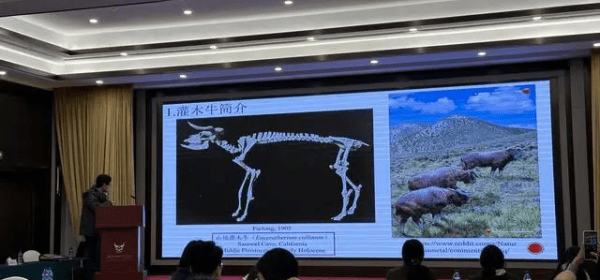
China: North American Shrub Ox Fossils Discovered in Eurasia! (24.10.2024)

Phylogenetic studies show that shrub oxen formed a sister group with musk oxen, indicating a closer evolutionary relationship between the two compared to other bovidae. 

“Building on previous research, we expanded our study to include Quaternary musk oxen and concluded that their evolution can indeed be divided into two groups: high-horned and low-horned species. These two groups migrated from Eurasia to North America during the Late Early Pleistocene to Early Middle Pleistocene, and the Late Middle Pleistocene, respectively,” Bai stated.

This research provides new material on the diversity and evolution of musk oxen and is significant for understanding faunal exchanges between Eurasia and North America during the Quaternary period.