King Arthur May Well Have Been a Historical Personage!

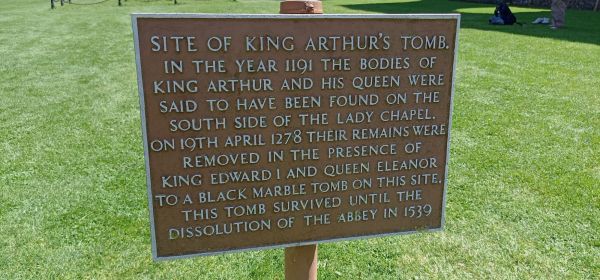
Glastonbury Abbey – King Arthur’s Grave! (29.7.2024)

The Celtic Church (from Egypt) was probably in Britain from the 2nd century CE onwards – with it being destroyed by the incoming Roman Catholic Church by the 11th century CE. Its monastic nature encouraged not only cloistered monks who lived in draughty stone cells – but also Hermits who lived in natural caves or various other meditation cells. Celtic Christianity did not persecute – but encouraged and accommodated the Pagan beliefs of indigenous people. There was a mutual respect between both groups of believers and this explains why leaders like King Arthur would strive to protect the Church – and the Church to honour him in death. This type of Asiatic respect does not require a slavish attachment to belief to be functional. Freedom of belief equates to respect for difference. There are many theories dating King Arthur from the 6th, 7th and 8th centuries, etc, which include many geographical areas associated with his life and death. We favour Tintagel in Cornwall – a place we have visited many times. King Arthur was a wise man, a compassionate man, and a great warrior!

Shine a Light on Me!

The Hermetica and Human Imagination! (3.6.2024)

In the Egyptian Hermetica, for instance, the god Toth (often through the commentary of Hermes) equates thinking about distant places (by imagining different physical environs in the mind) was exactly the same in principle as the individual travelling to these destinations – despite nothing physically taking place. Imagining structures in the mind, for Toth, was tantamount to creating something from nothing (every creationist story), and achieving movement without going anywhere. All theistic and psychedelic traditions make ample use of the ability to “imagine” – whilst the argument continues to as the proper relationship of the imagination to the physical world.

Museum Artefacts in St Albans!

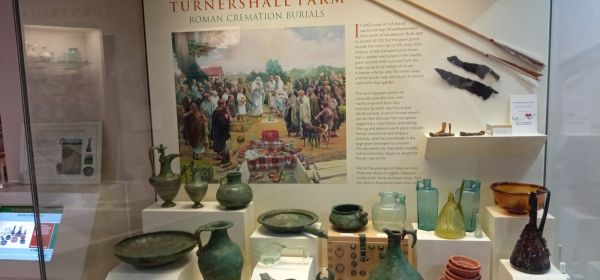
St Albans: Verulamium Museum! (29.5.2024)

Of course, Roman rule was collapsing by the time (in the 4th century) that Christianity was becoming popular throughout the Roman Empire. Some wealthy Romans tolerated Christianity prior to this date (perhaps 3rd century) as being just one of many choices of belief from across their Empire – as the Roman Authorities were not yet exclusively “Christian”. This is why Celtic Christianity was probably from Egypt and premised upon the monasticism of the Desert Fathers – having little directly to do with Rome. The Catholic Church did not arrive as a State power in England until the Norman Conquest of 1066 (isolated Catholic Churches and monasteries had arrived in England prior to this date – but possessed no political influence or power with England’s Celtic Chiefs or Anglo-Saxon Kings). In just one-hundred years of its arrival in 1066 – this new and aggressive type of intolerant Christianity had wiped-out its Celtic cousin by the 12th century.

Long Live the 1381 Peasants' Revolt!

St Albans Abbey: Main-Gate! (28.5.2024)

During 1381 – England came within a hair’s breadth of becoming a People’s Republic! This great effort led by Wat Tyler was eventually defeated through the duplicity of the ruling classes – but its example echoes down through history! The beginnings of this gate stem from the 11th century and the consolidation of the Norman Conquest. This was when Roman Catholicism landed in England as part of the ruling government structure. Prior to this, Celtic Christianity (probably from Egypt) held sway in England, Wales, Scotland and Ireland. What Catholic presence there was prior to 1066 CE was piece-meal and generally lacked any real political power or influence. The differwence between these two forms of Christianity is that although both possessed a monastic tradition – the Celtic version saw the monastery (not the Church) as the centre of society. Furthermore, the Celtic version possessed a tolerant attitude toward non-Christian beliefs – a position rejected by the Catholic variant. With the coming of the politically empowered Catholic Church – Celtic Christianity was all but wiped-out by the 12th century.

Zionist Genocide in Rafah!

Rafah: Egypt Confirms Israeii-Initiated “Genocide”! (15.5.2024)

Shoukry stressed that the Israeli control over the Palestinian side of the Rafah crossing, Israeli military operations in the vicinity of the crossing, and exposure of the lives of relief workers and truck drivers to imminent dangers are the main reasons for the inability to bring in aid from the crossing.

He also denounced the desperate attempts of the Israeli side to hold Egypt responsible for the unprecedented humanitarian crisis facing the Gaza Strip, affirming that it is a direct result of the indiscriminate Israeli attacks against the Palestinians for more than seven months which so far resulted in the killing of more than 35,000 citizens, mostly women and children.

He demanded Israel assume its legal responsibilities as the occupying power, by allowing aid to enter through the land ports under its control.

1 2 3 4 9