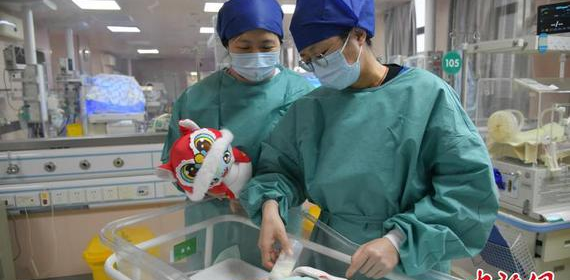
A Young Life is Saved in China!

China: Socialist Medicine Saves Premature Babies the NHS Allows to Die! (13.2.2025)

At 24 weeks, she suffered a large-scale early placental abruption, making it impossible to continue the pregnancy. Obstetricians acted swiftly to assist in the birth of a baby boy, Chaochao (pseudonym).

At birth, Chaochao was unable to breathe on his own. In the neonatal intensive care unit, medical staff adopted a step-by-step downgraded oxygen therapy approach, helping him successfully overcome the critical breathing.

Newborns normally require proper nutrition for growth and development. The nurses successfully performed catheterization on Chaochao’s hair-thin blood vessels.

His feeding was meticulously measured in grams, gradually increasing from 0.5 millilitres to 1 millilitre, then to 2 millilitres. After more than 90 days in the hospital, he reached a weight of 2.2 kilograms and was discharged on Feb. 1 to go home.

Mao Zedong's "Long March 1"!

China: How Mao Zedong’s Nuclear Submarine – “Long March 1” – Shocked the World! (7.2.2025)

Huang Xuhua, an academician of the Chinese Academy of Engineering, recipient of the Medal of the Republic, and chief designer of China’s first-generation nuclear submarines, passed away at the age of 99 on Thursday in Wuhan, Central China’s Hubei Province.

Known as the “father of China’s nuclear submarines,” Huang had dedicated his whole life to the development and advancement of China’s nuclear submarine programme.

UK: Bleak Poverty Statistics "Wearily Familiar" - Joseph Rowntree Foundation! (6.2.2025)

UK: Bleak Poverty Statistics “Wearily Familiar” – Joseph Rowntree Foundation! (6.2.2025)

Larger families with three or more children have consistently faced a higher rate of poverty, it says: 45 per cent of children in large families were in poverty in 2022/23. Disabled people, carers, renters, people claiming benefits, and people in workless households were also at a disproportionately higher risk of poverty.

More recent figures were equally bleak, owing to the continued affects of the cost-of-living crisis. In October 2024, about 2.6 million of the poorest fifth of households (44 per cent) were in arrears with their household bills or behind on scheduled lending repayments; 4.1 million households (69 per cent) were going without essentials; and 3.2 million households (54 per cent) cut back on food or went hungry.

Ebony and Ivory!

An Ovis Aries Revolution! – My Contribution to “Unherd” – I Doubt It Will Be Printed! (31.1.2025)

Sheep are very sensitive animals. This includes goats and rams – not always the same thing. Under Labour, the manner in which sheep congregate together has subtly shifted. In the average flock today, the shepherds will tell you that their is a profound sense of fear seven-days a week – and not just on Market-Day – or when the “special” lorry arrives. The texture of the wool has diminished in quality – as has the production of milk and meat. As you know, sheep-milk is used to make a myriad of alternative dairy products – including niche cheese and yoghurt. Yes – such products cost a little more – but this reflects the greater extent of labour required to manufacture these products.

Russia: 81th Anniversary of the Liberation of Leningrad from Nazi German & Finnish Tyranny! (27.1.2025)

At the Piskaryovskoye Memorial Cemetery of St Petersburg (Leningrad), the President laid a wreath at the Motherland monument to honour the memory of the fallen Leningrad residents and defenders.

At least 420,000 civilians of Leningrad who died from starvation, cold, and disease, or in air-raids, as well as 70,000 soldiers are buried in the cemetery’s 186 communal graves and 6,000 individual military graves.

The memorial wall behind the Motherland monument carries the words by poet Olga Bergholz: “No one is forgotten, nothing is forgotten.”

Women Were Treated Very Well!

London: Broken Biscuits and Paternalistic Capitalism: Was the Bermondsey Biscuit Factory a Worker’s Paradise or is the Truth Less Sweet? (13.1.2025)

The first female clerks, responsible for typewriting invoices and the telephone exchange, were employed in 1885. The new hires may have been surprised to find the company brochure had a dedicated ladies’ section called ‘Matters Feminine’. However, the suffragettes would not have been too impressed with its content. Topics mainly included cooking, family and fashion. 

‘It is all very well for a man to smile at the feminine love of clothes, and dismiss them as being of very little importance in life. Women know better. Husbands, who profess not to admire fashions, are not slow to complain at the dowdy appearance of their wives,’ read one passage. 

In the following decades, many of the women employed found promotions were very much possible. Anne Edwards, who got a job as a clerical assistant in 1957, wrote: “Brilliant employers, they paid for me to attend Pitman’s College to extend my shorthand skills. They monitored my progress, my typewriting skills and promoted me from junior to manager’s secretary in the same department. I loved working there.”

1 6 7 8 9 10 33