Socialist China Plans New Space Adventure!

China: Plans for Satellite Launch to Search for “New Earth”! (26.11.2025)

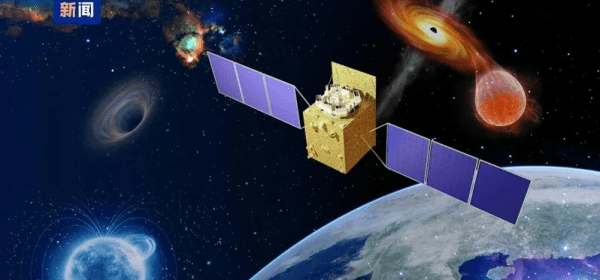
The Hongmeng Programme, designed to detect the universe’s “infant cries,” consists of 10 satellites forming a low-frequency radio telescope array. The satellites will travel to the far side of the Moon, a naturally quiet “radio sanctuary” shielded from Earth and solar interference, allowing the system to capture extremely faint signals from deep space. The project aims to shed light on the turbulent epoch hundreds of millions of years after the Big Bang, before the first stars formed.

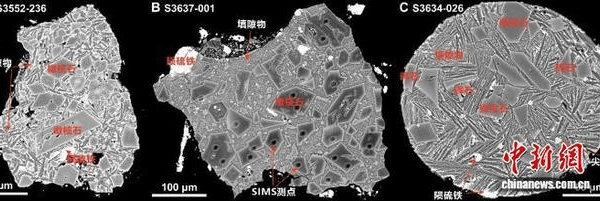
Fragments of impactor residues identified in the lunar soil of Chang'e-6 in this study. Photo courtesy of the scientific research team of the Guangzhou Institute of Geochemistry, Chinese Academy of Sciences

China: Scientists Discover Rare Meteorite Relics in Chang’e-6 Far-Side Lunar Samples! (21.10.2025)

Using advanced techniques to examine mineral composition and oxygen isotopes, the researchers scrutinized lunar soil and confirmed that the fragments came from CI-like chondrites — a type of meteorite rich in water and organic materials that typically originates in the outer Solar System.

The study implies that the Earth-Moon system may have experienced more collisions from carbonaceous chondrites than scientists had previously estimated.

This discovery not only indicates that material from the outer Solar System can migrate to the inner Solar System, but also has important implications for explaining the origin of water on the lunar surface, said Lin Mang, a researcher at GIG.

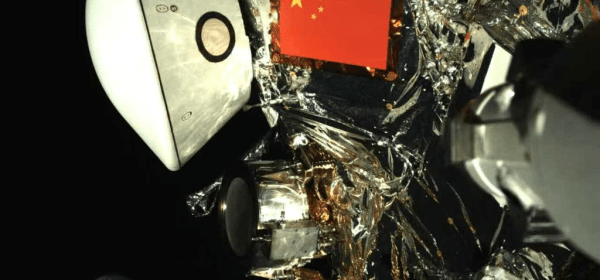
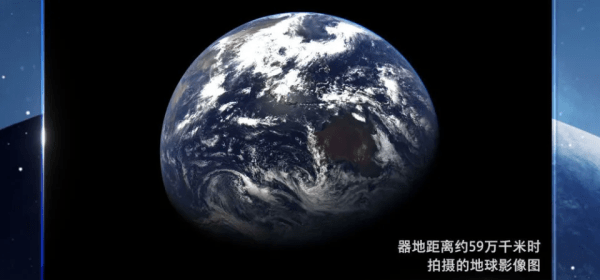
This image released by the China National Space Administration (CNSA) on Oct. 1, 2025 shows a view of the Tianwen-2 probe alongside Earth, captured by the probe during its deep-space journey. The newly released image, acquired by a monitoring camera mounted on the probe's robotic arm, showcases China's five-starred red flag and the white return capsule against the backdrop of a distant, blue Earth. (CNSA/Handout via Xinhua)

China: Tianwen-2 Probe Captures “Selfie” with Earth! (1.10.2025)

The probe has successfully completed a series of in-orbit tests, including the deployment of sampling devices and self-checks of electronic devices. All systems are reported to be functioning normally, while onboard instruments have begun collecting valuable scientific data on the space environment, according to the CNSA.

China launched its first asteroid sample-return mission, Tianwen-2, on May 29 — an endeavour to shed light on the formation and evolution of asteroids and the early solar system.

The mission aims to achieve multiple goals over a decade-long expedition: collecting samples from near-Earth asteroid 2016HO3 and exploring the main-belt comet 311P, which is farther from Earth than Mars.

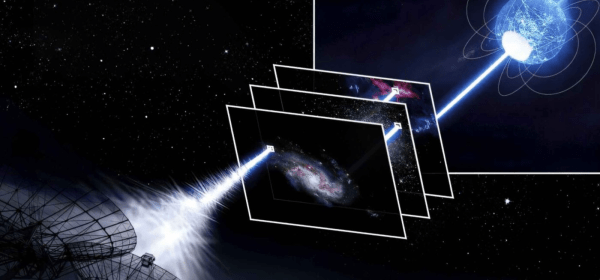
reached Earth after traveling 10 billion years through space

Space: Fast Radio Burst [FRB] Reaches Earth After Travelling 10 Billion Years! (23.9.2025)

Why cosmic noon matters

The burst came from a time nicknamed “cosmic noon,” when the universe was forming stars at its fastest rate.

Astronomers see a peak in the cosmic star formation history about 10 to 11 billion years ago, and this event sits in that era.

Finding an FRB there matters for more than a date on a timeline. It shows that whatever powers FRBs was active when young galaxies were busy building their stars.

“This discovery doubles the redshift reach of localized FRBs. Our observations establish FRB activity during the peak of cosmic star formation” wrote Caleb.

Images of Earth and the moon captured by the Tianwen 2 robotic probe are released on Tuesday by the China National Space Administration.

China: Tianwen 2 Sends Back Images of Earth & Moon! (2.7.2025)

The samples will be distributed among scientists, who will examine their physical properties, chemical and mineralogical content and isotopic composition, contributing to studies on the formation and evolution of asteroids and the early solar system.

Delivering the samples to Earth will not be the end of the mission. The Tianwen 2 spacecraft will then enter the second phase of its journey, flying toward a main-belt comet called 311P to conduct a remote-sensing survey and transmit the data back to Earth for scientific research, according to the CNSA.

The whole mission is expected to yield ground-breaking discoveries and expand the understanding of Earth and small celestial bodies inside the solar system, scientists said.

Chinese New Year - 2926-4723! - Year of the [Yin] Wood Green Snake!

Chinese New Year [2025-4723] Year of the [Yin] Wood Green Snake! (15.1.2025)

Wearing red is not limited to red clothes, red socks, and red belts, but can also be red jewellery, red mobile phone cases, as long as the items you carry with you are red.

There are two special days when wearing red is appropriate:

i) The first day of the first lunar month, during the Spring Festival, wearing red can add to the festive mood.

ii) The second is the beginning of Spring. As the beginning of the year, the beginning of Spring means the start of a new cycle.

Within China, there is a custom of “Avoiding Spring” (避春 – Bi Chun) at the beginning of Spring, that is, avoiding offending the numerous “Tai Sui” (太岁 – “Grand Aged”) gods that equate to the 12 stars opposite Jupiter (later expanded to 60 deities) – so people choose to wear red on this day in the hope of bringing good luck.

Everyone shapes their own destiny. Hard work, kindness and wise choices will help you succeed.

No matter what – I hope everyone will experience a smooth journey throughout the Year of the Snake (2025-4723) and welcome the arrival of boundless happiness and good luck!

1 2 3 4