Master Ti Guang - Patchwork Robe

The Pure Behaviour of Ch’an Master Ti Guang [体光] (1924-2005)! [22.10.2024]

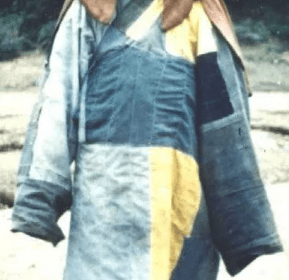
This is why Master Ti Guang had perfected the realisation of “stillness” (emptiness) and “movement” (function) – and was able to express this through a martial technique free of greed, hatred, and delusion. All year roung, Master Ti Guang wore a tattered, patchwork robe – following the Buddha’s original example of only wearing a robe constructed out of tattered clothing taken from the rotting corpses lying around in the charnel grounds of ancient India. Master Ti Guang never ate any food after noon each day. Master Ti Guang understood (and followed) all the rules and regulations governing the strict discipline of the Meditation hall. As a consequence, Master Ti Guang had stilled and expanded his mind, and manifested endless degrees of insightul wisdom throughout his life!
Defining ‘Emptiness’ (Sunnata) and ‘Nothingness’ (Akincanna)! (5.2.2023) 

What does this mean? Dull nothingness (akincanna) is a thought form with a non-descript content. In other words, a thought is generated which is defined by the usual boundaries and parameters that constitute the average structured ‘thought’ form – but the meditator misunderstands this ‘non-descript’ content and mistakenly grasps it as being the empty mind ground. The trap here is that a manifest ‘thought’ (and stream of thought) is masquerading as the psychic fabric from which all structured thought arises – and which pre-exists all thought. This state is mistaken as complete and perfect enlightenment and those trapped within it start misleading others down the wrong path.

The Zen of No Ch’an

Needless to say, the traditional Chinese Ch’an Buddhist – Master Xu Yun – had no formal or informal ties or connections to Japanese Zen Buddhism, and never practised (or advocated others to practice) a Japanese Zen that does not follow the Vinaya Disciple, and which deviates from established Ch’an practice.

Master Xu Yun: On the Relationship Between Ch’an & Pure Land Buddhism

Then Mahakasyapa transmitted to him the Tathagata’s Mind Seal, making him the second Indian Patriarch. The transmission was handed down to following generations, and after the Patriarchs Asvaghosa and Nagarjuna, Chan Master Hui-wen of Tian-tai Mountain in the Bei-qi Dynasty (550-78) after reading (Nagarjuna’s) Madhyamika Shastra, succeeded in realizing his own mind and founded the Tian-tai School.269 At the time, our Chan Sect was very flourishing.

1 2