David Irving Looking Casual for Alek Yerbury!

Email: Alek Yerbury Writes to David Irving! (6.5.2025)

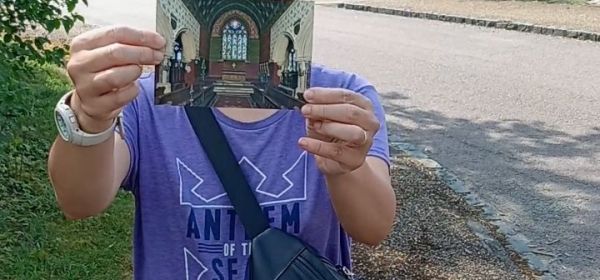
Of course, you may notice my more than ample chest in the photograph. Unfortunately, whilst fumbling around in the dark, I mistakenly swallowed a couple of my partner’s female hormone pills (“Kate” has to regularly take these since the “transition” – something I do not wish to discuss – other than to say I am not gay). I want to get all this off my chest (no pun intended) as I suspect you will experience a spike in book-sales in the very near future. We are thinking of holding the David Irving Symposium in Newton Abbott as virtually everyone there is White – even the hordes of Ukrainian migrants that have flooded the place. Thank goodness the Hong Kong rioters cannot yet read English maps – or we’d have to find a new venue!

Steam Train Travelling Through Galmpton!

UK: Galmpton Sheep & Steam Train! (15.4.2025)

I also remember a “93” double-decker bus in Dartmouth. Why? well, in Sutton – where we live – the “93” TFL bus begins in Priory Road (travelling to Putney Bridge) – we used to live in Priory Road from 1998-2004. We now live one or two streets away – but still near this bus route. This bus travels via Wimbledon Common – near to where the Buddhapadipa Buddhist Temple is located. Believe it or not – there is a Buddhist Temple near Honiton in Devon (Upottery) – the Hartridge Buddhist Monastery. We have visited this place many years ago – and might well visit again sometime soon.

Gee's Birthday Treat - Cornish Cream Tea!

UK: Gee’s Birthday Treat – Cornish Cream Tea! (5.12.2024)

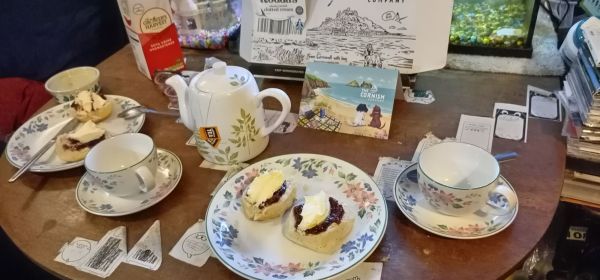
The box is delivered by a private Courier and contains four scones, four pots of jam, four tea-bags, two-bags of biscuits, and a pot of clotted cream! We breakout the best China tea-pot and tea-cups and saucers to consume this magnificent gift! As my parents live in Devon, we often visit nearby Cornwall and appreciate the history and old buildings. Cornwall is essentially a “Celtic” region of the UK with kilts, bagpipes and a Gaelic language all of its own!

Galmptom Traction Engine

Galmpton: Encountering a Superb Traction Engine! (1.8.2024)

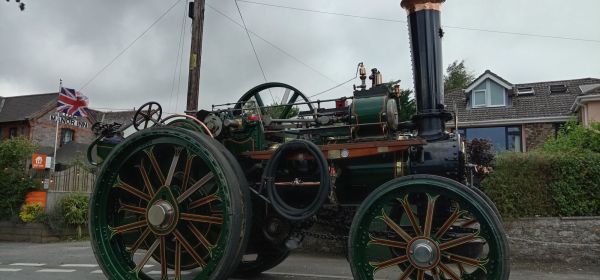
Indeed, what Goldsworthy Gurney first envisioned as an “Automobile” to be driven on open roads – became widely known as a “Traction Engine” from around 1850 in the UK. Ironically, whilst carry a single driver on country roads – whilst moving between farming fields – these devices were not allowed to evolve into the Motor Car envisioned by Goldsworthy Gurney. Only much later would a petrol-driven motor car be allowed to be developed. Whilst driving back from Exeter to Galmpton on Friday evening (Friday, August 1st, 2024) – whilst traversing the narrow streets of Galmpton – we encountered the above “Traction Engine” which was apparently joining many other examples in a local fayre that was about to be held! How lucky we were!

Possibly the Narrowest Street in the World!

Exeter: Parliament Street – the Narrowest Street in the World! (2.8.2024)

However, in 1660 a counter-Revolution occurred that saw the Bourgeoisie retain their power – but switch their allegiance away from the peasants and workers and back in favour of the aristocracy and the royal family (although being careful to only reintroduce a Constitutional Monarchy with any real or actual power). Voting for the masses was abandoned – with voting only encouraged amongst the most wealthiest and influential of the post-Cromwellian middle class. I mention this as some have speculated that Parliament Street was renamed as such – as a slight against Cromwell – but I doubt this. Prior to the counter-Revolution of 1660 – Cromwell was very popular and was so powerful that anyone with sense would not dare risk their lives by doing something so stupid as altering a street name.

King Arthur May Well Have Been a Historical Personage!

Glastonbury Abbey – King Arthur’s Grave! (29.7.2024)

The Celtic Church (from Egypt) was probably in Britain from the 2nd century CE onwards – with it being destroyed by the incoming Roman Catholic Church by the 11th century CE. Its monastic nature encouraged not only cloistered monks who lived in draughty stone cells – but also Hermits who lived in natural caves or various other meditation cells. Celtic Christianity did not persecute – but encouraged and accommodated the Pagan beliefs of indigenous people. There was a mutual respect between both groups of believers and this explains why leaders like King Arthur would strive to protect the Church – and the Church to honour him in death. This type of Asiatic respect does not require a slavish attachment to belief to be functional. Freedom of belief equates to respect for difference. There are many theories dating King Arthur from the 6th, 7th and 8th centuries, etc, which include many geographical areas associated with his life and death. We favour Tintagel in Cornwall – a place we have visited many times. King Arthur was a wise man, a compassionate man, and a great warrior!

1 2 3 4 6