Why Was the Dead Body of Karl Marx Not Cremated? (26.12.2022) 

What we do know is that the mortal remains of Karl Marx are believed to lay in the soil of Highgate Cemetery under a marble monument placed over the grave during 1956 (replacing an older and much smaller gravestone – the current location of which I do not know). Although Karl Marx is often (disparagingly) referred to as a ‘Jew’ – in no way was his burial in Highgate Cemetery in accordance with Jewish tradition (of respectful encasement within a spotless ‘Mausoleum’). At least on that footing we are safe. As there was no ‘Cross’ placed over his grave either – the idea of a ‘Christian’ burial can also be dismissed. We are then left with what looks like an ‘irreligious’ burial very much in accordance with the ‘Atheistic’ or at least ‘non-religious’ ideology of Marx and Engels! As this happened just before the development of ‘Cremation’ as a regular or officially sanctioned activity – the physical remains of Karl Marx still exist. I believe an interesting scientific study could be carried-out if these remains were exhumed and subject to extensive DNA testing. A far more secure and efficient casket could then be designed to hold these remains and they could be more securely interred – protected from the hatred of the Bourgeoisie, their religious lackeys and the political far-right! 

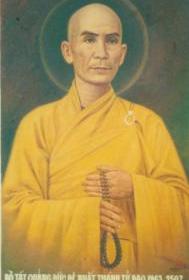
Thich Quang Duc (释广德) [1897-1963]

Thich Quang Duc’s action produced a mind altering paradigm shift throughout the world that is still being discussed today. He demonstrated the power of Buddhist mind control during a very painful death – whereas no Christian believers (beyond the realms of imagination, superstition, or the paranormal) have managed to rise from the dead.

Shao Yun’s Recollections of Master Xu Yun

‘Dharma master Shao Yun was born in the Anhui province of eastern China in 1938. His family name was Huang (黄). Whilst in his school years, he developed an interest in Buddhist studies and read books upon the subject of the three treasures. At the age of around 19 years old (in 1956/57), he travelled to Yunjushan (Jiangxi), and encountered master Xu Yun living at Zhen Ru Monastery – the old master at this time was 117 years old. Xu Yun was in the midst of re-building the substantial monastic grounds, so that the holy area could re-capture some of the spiritual glories the site had held during the Tang and Song Dynasties. Master Xu Yun enquired as to why Shao Yun wanted to be a Ch’an monk – and the young man answered that he wanted to become a Buddha. Xu Yun was over-joyed to hear this response and immediately received him as a disciple and personally arranged for the ordination. Xu Yun gave him two Dharma names; the first was ‘Xuan De’ (宣德), or ‘Propagate Virtue’, and the second was ‘Shao Yun’ (绍云), or ‘Continues Speech’. Despite the country ofChinaexperiencing an ever chaotic political and cultural situation, Xu Yun had managed, through the example of spiritual power, to turn Zhen Ru into an oasis of Buddhist wisdom and peace. The impression received from reading Xu Yun’s autobiography is that through sheer strength of character, and despite the odds being stacked firmly against him, nevertheless, he managed to create Dharmically significant worlds within situations that were otherwise hopelessly lost. The young monk Shao Yun walked into one of these places, and has recently recorded his recollections of the experience of living life with master Xu Yun during his final years – in a speech given to Hong Kong Buddhists. Once Shao Yun had settled down to monastic life, and had gotten use to the life of a Ch’an monk, he eventually became Xu Yun’s attendant, watching over the old monk and assisting with the necessary every day duties that such a post entails. What follows is a translation from the original Chinese document entitled ‘绍云法师; 虚云老和尚神通示现’, or ‘Dharma Master Shao Yun; The Manifestation of the Monk Xu Yun’s Unhindered Spiritual Power’. Shao Yun describes the old monk Xu Yun in the following way;’