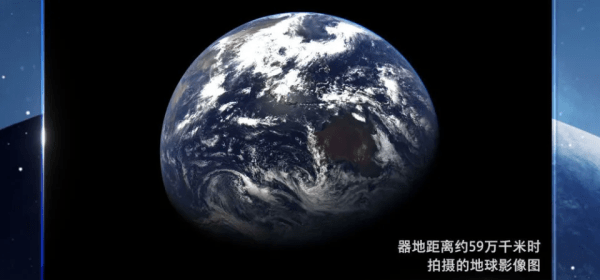
Images of Earth and the moon captured by the Tianwen 2 robotic probe are released on Tuesday by the China National Space Administration.

China: Tianwen 2 Sends Back Images of Earth & Moon! (2.7.2025)

The samples will be distributed among scientists, who will examine their physical properties, chemical and mineralogical content and isotopic composition, contributing to studies on the formation and evolution of asteroids and the early solar system.

Delivering the samples to Earth will not be the end of the mission. The Tianwen 2 spacecraft will then enter the second phase of its journey, flying toward a main-belt comet called 311P to conduct a remote-sensing survey and transmit the data back to Earth for scientific research, according to the CNSA.

The whole mission is expected to yield ground-breaking discoveries and expand the understanding of Earth and small celestial bodies inside the solar system, scientists said.
Carrying the Tianwen 2 robotic probe, a Long March 3B rocket blasted off at 1:31 am at the Xichang Satellite Launch Center in the middle of mountains in Sichuan province.

China: First “Asteroid Sampling” [Tianwen II (天问二) “Divine-Sky Exploration II”] Mission Launched! (29.5.2025)

The administration said that mission planners aim to accomplish two major engineering goals through the Tianwen 2 project. The first is to develop and demonstrate key technologies needed for gathering sample from weak-gravity celestial bodies, conducting high-precision autonomous navigation and control, and other crucial manoeuvres. The second is to obtain data and samples to facilitate studies on the origins and evolution of asteroids.

Scientifically, planners hope the spacecraft could measure multiple physical parameters of both 2016 HO3 and 311P, covering their size and shape, orbital traits, rotation patterns, and thermal radiation characteristics, allowing for research on their orbital dynamics. Researchers will also analyse their external features, material compositions, internal structures, and potential ejecta.

Rock Samples Return!

China: Chang’e-6 Lunar Module Safely Returns Dark-Side Rock Samples! (26.6.2024)

Lunar samples brought by the earlier Chang’e-5 mission have already drawn applications for access from international scholars, with the process well underway. The Chang’e-6 lunar probe carried four international payloads that were developed jointly by Chinese and foreign scientists. It is conceivable that the openness of Chinese lunar exploration activities will be mirrored in the study of Chang’e-6 lunar samples, said Yang.

The lunar scientific community and the entire humankind are anticipated to reap the rewards of collaborative efforts undertaken by international scientists from a wide range of geographical and disciplinary backgrounds, Yang added.

Zhang Kejian, head of the CNSA, said that exploring the vast universe is a common dream for all of humanity, and only open cooperation is the right path. China’s space endeavors will adhere to the principles of equality and mutual benefit, peaceful utilization, and inclusive development.

China's Socialist Science Leads the World!

China Focus: Foreign Scientists Thank China for Sharing Lunar Exploration Opportunity! (3.6.2024)

The lander of the Chang’e-6 spacecraft also carried an instrument, called Negative Ions on the Lunar Surface (NILS), developed by the ESA/Sweden to the moon, which will be used to detect negative ions and study the interaction between plasma and the lunar surface.

Neil Melville-Kenney, NILS technical officer of the ESA, said the CNSA’s initiative to invite international partners to participate in the Chang’e-6 mission is very much appreciated by the international community.

“It’s a very impressive mission, a very ambitious mission. So we are very pleased to be a part of it. And the collaboration has gone very smoothly. Now we are waiting for the payload to be turned on so that we can get our first data,” he said.

“It’s very important to have international cooperation for space exploration. I think space exploration encourages us to consider our planet as one and our people as one. And it’s important that we work together as we start to explore the solar system more and more. Together we can achieve greater things,” he added.

China Releases First Batch of Research from Mars Exploration! (19.9.2022)

Scientists have also found that the Martian soil has high bearing strength and low friction parameters, revealing the site where the rover landed must have experienced wind and possibly water erosion.

These results revealed the impact of wind and water activities on Mars’ geological evolution and environmental changes, and provided support for the hypothesis that there was once an ocean in the Utopian Planitia, according to the CNSA.

In addition, Chinese scientists have obtained a number of scientific results on the relationship between the density of rocks on the Martian surface and the degree of surface erosion, the distribution of ions and neutral particles in the near-Mars space environment, and the gravity field of Mars.