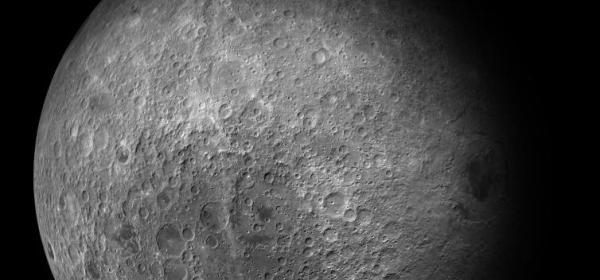
This image created by Chinese researchers shows the moon's far side.

China: Chang’e-6 Sheds First-Light on Evolution History of Moon’s Dark-Side! (10.7.2025)

In 2024, Chang’e-6 made history by bringing 1,935.3 grams of lunar far-side samples back to Earth. These samples were collected from the South Pole-Aitken (SPA) Basin, the largest, deepest and oldest basin on the moon, which provided a rare opportunity to clarify the compositional differences between the near and far sides and to unravel the long-standing mystery of their asymmetry.

“The SPA Basin is one of the moon’s three major tectonic units, measuring approximately 2,500 kilometers in diameter. The energy from the impact that formed this crater is estimated to be 1 trillion times greater than that of an atomic bomb explosion. Yet, the exact influence of such a massive collision on the moon’s evolution has remained an unsolved mystery,” Wu Fuyuan, an academician of CAS and a leading researcher with the IGG, said at a CAS press conference on Wednesday.

The four papers published in Nature systematically reveal, for the first time, the effects of this colossal impact, which is the core highlight of these findings, said Wu.

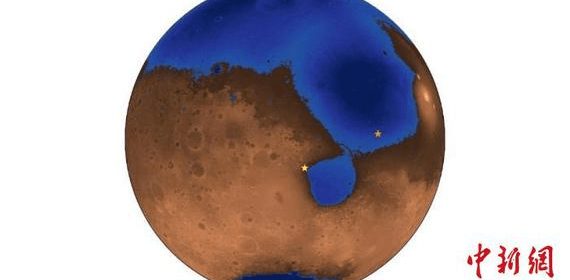
A hypothetical illustration of Mars 3.6 billion years ago.(Photo/Aerospace Information Research Institute)

China’s Mars Rover Data Suggests Existence of Ancient Oceans on Mars! (3.3.2025)

If an ocean once existed in this region, climate changes could have trapped large amounts of water in the form of subsurface ice, which holds great potential for future Mars base water resources, significantly reducing the cost of construction and maintenance.

Fang emphasized that the ancient oceanic sediments preserve records of Mars’ climatic history. Studying these sediments could help people understand how the planet transitioned from a warm, wet world to a cold, arid one. This knowledge could guide efforts to terraform Mars into a long-term sustainable human habitation, according to Fang.

Fang mentioned that Zhurong landed in the southern part of Utopia Planitia in mid-May 2021. It is equipped with a subsurface penetrating radar to explore underground structures and potential water ice deposits.

Socialist Science Triumphs!

China: Socialist Light Shone on “Big Bang”! (26.1.2025)

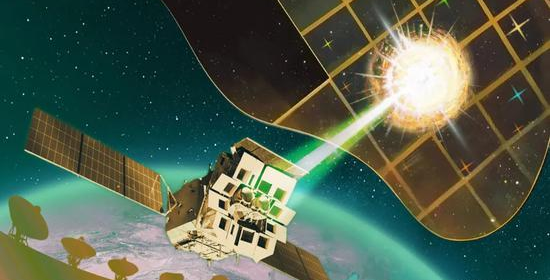
Many experts at home and abroad said that the observation results of EP240315a by the EP satellite have deepened humanity’s understanding of early universe gamma-ray bursts, offer fresh insights into the origins and evolution of the universe, Xinhua reported.

The EP mission is one of a series of space science missions led by CAS. This is an international collaboration effort, featuring contributions from the European Space Agency (ESA), the Max Planck Institute for Extra-terrestrial Physics (MPE) in Germany, and the French space agency CNES.

Launched into space in January 2024, the satellite has achieved several initial discoveries, such as an uncommon transient phenomenon, advancing understanding of the universe and extreme physical phenomena, Xinhua reported.